Alef Rank Tracking Workspace: One Dashboard for SERP and AI Positions
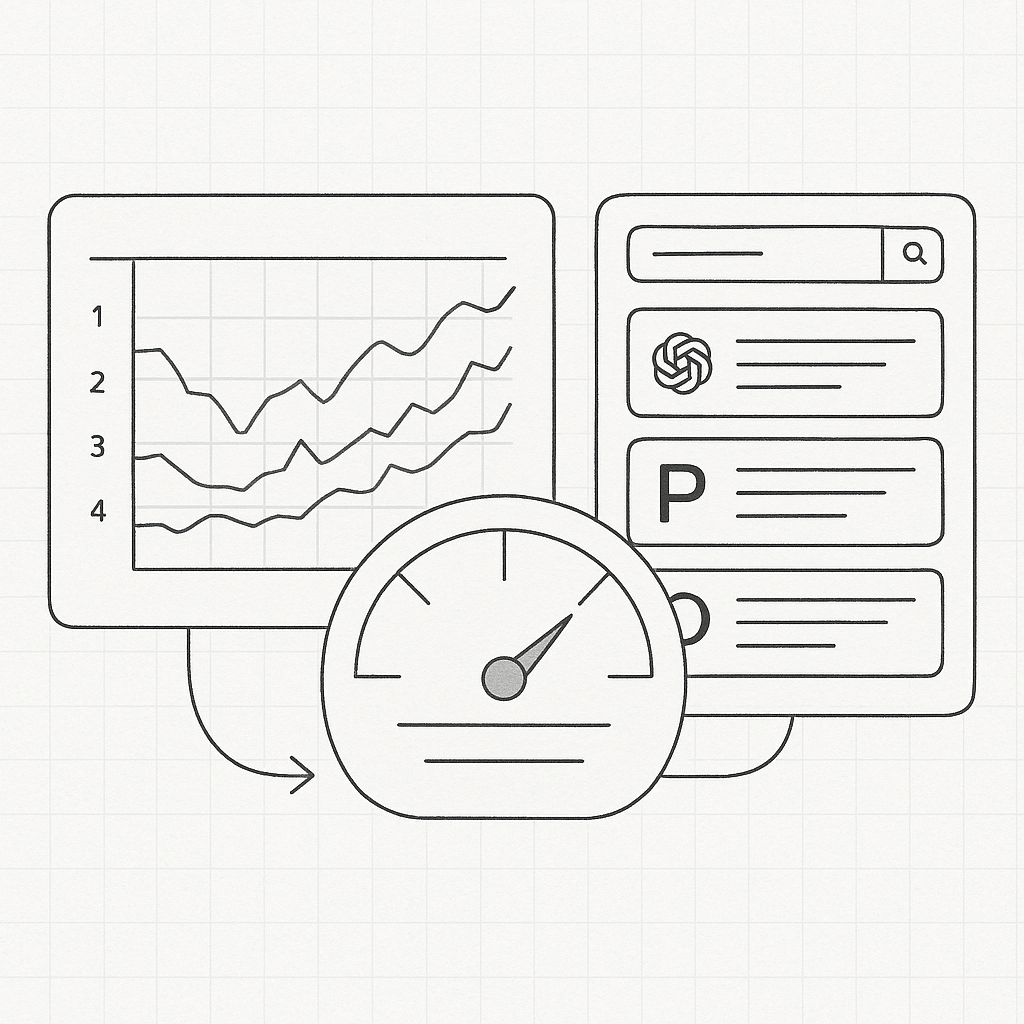
The Alef rank tracking workspace holds Google SERP positions and AI answer engine visibility in one dashboard, so agencies stop reconciling two tools.
Intro
ChatGPT's crawler now issues 3.6 times more requests than Googlebot, according to Search Engine Journal's analysis of 24.4 million proxy requests across 69 sites. Most rank trackers, however, still report only blue-link Google positions. That gap defines the modern agency problem: a client can hold position #1 on Google and be entirely absent from the ChatGPT answer to the same query, with no single screen showing both outcomes side by side.
The reconciliation cost is measurable. Agencies report spending roughly 11.2 hours per client per month assembling and formatting reports, per AgencyAnalytics' State of Agency Reporting (2026), and split tooling multiplies that burden. An Alef rank tracking workspace addresses this directly: it is the AI visibility engine that tracks Google, ChatGPT, Perplexity, Gemini, and Copilot in one place. This article explains workspace setup, keyword and prompt grouping, check cadence, and how raw position data becomes client-ready output — including the distinctions covered in AI search visibility versus Google rankings and the advanced rank tracking capabilities that separate agency-grade platforms from basic checkers.
The solution
Alef's answer to that reconciliation problem is structural rather than cosmetic. The Alef rank tracking workspace is a single environment in which a domain, its competitors, its keyword set, and its prompt set are configured once and then monitored together. Because traditional SERP positions and AI answer engine presence share one data model, a rank movement and a citation change can be read side by side instead of in two browser tabs with two different timestamps.
That distinction matters more each quarter. Google AI Overviews now appear in 39% of U.S. desktop searches according to Comscore data reported by Search Engine Land, and Pew Research Center found users click links less often when an AI summary appears. Split-tool setups force agencies to assemble that picture manually, reconciling mismatched dates and definitions.
The workspace is organized around projects — one per client, domain, and market — which is what makes multi-client work tractable rather than a spreadsheet exercise. Each project rolls its keyword and prompt coverage into a unified visibility score, a single number a client can follow month over month. The broader Alef solutions overview shows how that score connects to content and backlink workflows, while AI visibility tracking covers answer engine coverage in depth.
How it works
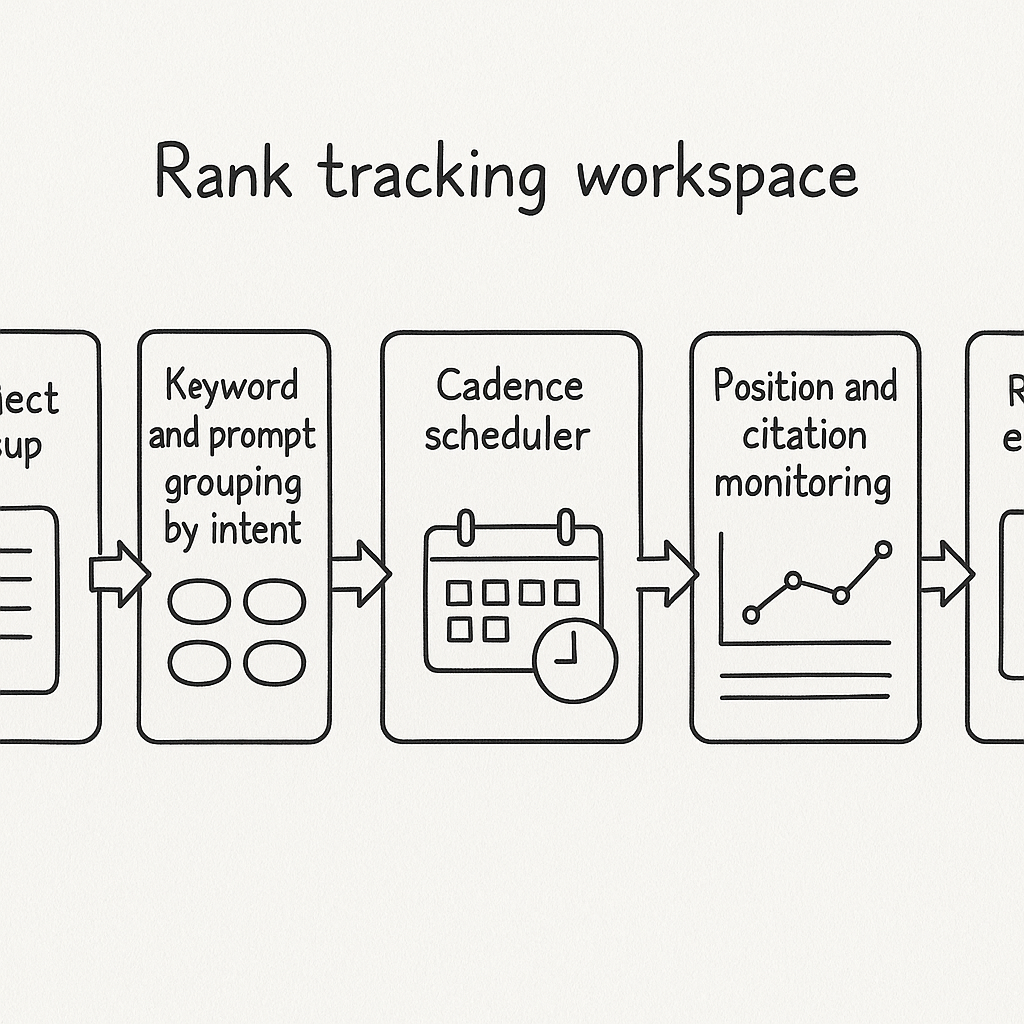
The workspace follows a linear flow: scope the client, organize what gets tracked, schedule the checks, read the signals, then ship the deliverable. Each stage builds on the one before it.
- Set up the workspace. Add the client domain and its named competitors as a project. Every keyword, prompt, and citation recorded afterward stays scoped to that client, so a multi-client agency never has to untangle whose data belongs to whom.
- Group keywords and prompts. Organize tracked Google keywords and tracked AI prompts by topic, intent (discovery, comparison, buying), market, and audience. Grouping by intent means reporting maps to the client's funnel rather than a flat list of terms.
- Set check cadence. Daily Google SERP checks run alongside scheduled AI prompt runs, with cadence configurable per client — weekly refresh for enterprise accounts, monthly for smaller retainers. Alef's Prompt Tracker runs structured buyer questions through ChatGPT, Gemini, and Perplexity to measure visibility, mentions, and source citations, which is where prompt-level visibility tracking becomes measurable rather than anecdotal.
- Monitor positions and citations. The workspace records SERP position, SERP features (AI Overviews, featured snippets, local packs), AI mentions, citations, sentiment, and competitor share of voice in one view. That consolidation matters as AI Overviews now appear in 39% of U.S. desktop searches (Search Engine Land).
- Turn data into client-ready output. Position and citation history flow into reports and dashboards that can be shared or white-labeled, closing the loop from raw check to deliverable. For agencies running this across a book of accounts, the multi-client SEO reporting workflow describes how that handoff scales.
The benefits
The value of consolidating SERP and AI data into one workspace is not aesthetic. It is operational. Each benefit below maps to a specific cost that agencies currently absorb — in hours, in reporting risk, or in missed opportunity — and to the mechanism inside the Alef rank tracking workspace that removes it.
Benefit 1 — One source of truth ends the reconciliation step
The typical agency stack pairs a traditional rank tracker with a separate AI visibility tool, then bridges them in a spreadsheet. That bridge is manual: export positions, export AI mentions, match keyword lists that rarely align one-to-one, and rebuild the join every reporting cycle. Every handoff between two systems is a place where data drifts, labels diverge, and an analyst spends time on assembly rather than analysis.
The Alef rank tracking workspace eliminates the bridge by holding Google positions and AI answer engine presence in the same project structure, keyed to the same keyword and prompt groups. There is no export-import step, no version conflict between two CSVs, and no question about which file is current. For an agency running ten accounts, the reconciliation step alone can consume the equivalent of a working day per month — time that returns to strategy, content briefs, and client communication.
Benefit 2 — Two-channel coverage exposes the gaps a single tracker hides
A number-one Google ranking no longer guarantees visibility. Pew Research Center found that Google users are less likely to click on links when an AI summary appears in the results, and Comscore data reported by Search Engine Land shows Google AI Overviews appearing in 39% of U.S. desktop searches. A rank tracker that stops at position one therefore reports a success that may not translate into sessions.
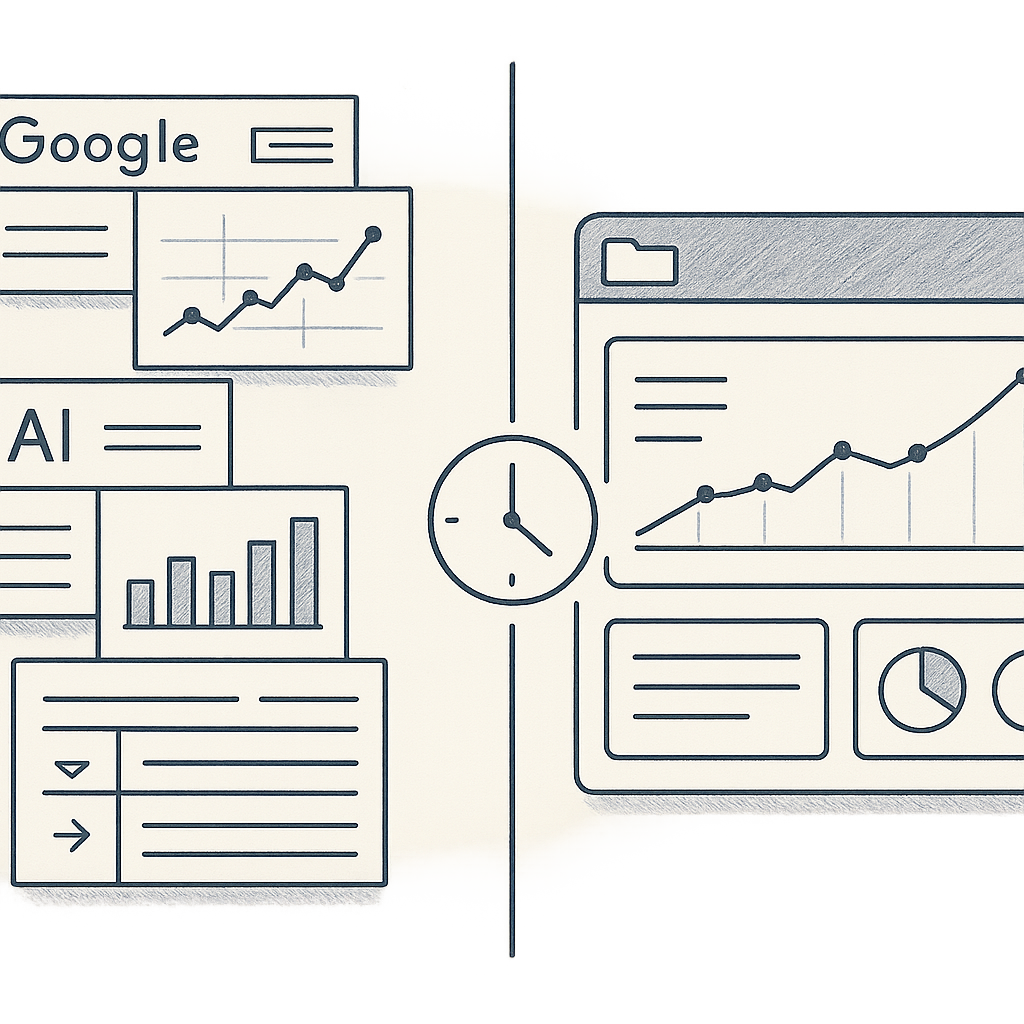
Reading both channels together changes the diagnosis. When a keyword ranks first organically but the client's domain never appears among the sources supporting the AI answer, that is a content and entity gap — not a ranking problem. The workspace surfaces it as a visible discrepancy rather than burying it across two dashboards. A comparison of what single-channel tools miss is covered in the breakdown of rank tracking tools and their blind spots.
Benefit 3 — Multi-client scale without cross-contamination
Spreadsheets fail at scale for a structural reason: they have no concept of a project boundary. One mis-dragged formula and Client A's keyword set is feeding Client B's share-of-voice calculation. At five clients this is a nuisance; at thirty it is a liability.
The Alef multi-client workspace treats each client as an isolated project with its own domains, target markets, language settings, and keyword and prompt groups. Isolation is enforced at the data layer, not by convention. At the same time, projects share a common schema, which means an agency can compare a SaaS client's AI citation rate against a retail client's without reformatting anything. Isolation and comparability are usually a trade-off in spreadsheet workflows; in a structured workspace they coexist.
Benefit 4 — Intent-mapped tracking turns terms into funnel stages
A flat keyword list answers "where do we rank?" It does not answer "does this matter to the business?" Grouping keywords and prompts by topic and intent — informational, commercial, transactional, branded — ties every tracked term to a stage of the buyer journey.
This changes what a report can say. Instead of a table of 400 positions, the agency can state that the client holds top-three positions on 68% of transactional terms but appears in only 12% of informational AI answers, which is where early-stage research now happens. That is a defensible strategic recommendation, and it comes from the group structure rather than from post-hoc analysis. The grouping also determines which prompts get run against which AI engines, so tracking effort concentrates where commercial value sits.
Benefit 5 — Configurable cadence matches refresh rate to client tier
Not every account justifies a daily check. A local service client with a stable ten-keyword footprint and an enterprise client with 2,000 tracked terms across four markets have different monitoring economics. Forcing one cadence on both either overspends on the small account or under-serves the large one.
The workspace allows daily SERP checks on high-priority groups while scheduling AI prompt runs at a different interval — weekly for broad awareness prompts, daily for competitive commercial prompts. Cadence is set per project and per group, so a retainer tier maps directly to a monitoring tier. The practical effect is that check frequency becomes a line item the agency can price, rather than a fixed cost absorbed across all clients.
Benefit 6 — AI citation visibility shows whose content supports the answer
An AI answer engine does not rank pages; it synthesizes an answer and cites sources. Knowing the client ranks is therefore insufficient — the operative question is whether the client's content is among the citations. Search Engine Journal's analysis of 24 million crawl requests found ChatGPT crawling 3.6 times more than Googlebot, which indicates how aggressively AI systems are sourcing material to cite.
The workspace surfaces the sources supporting each tracked AI answer, so the agency can see at a glance whether the client's domain appears, which competitor domains appear instead, and which third-party pages are being treated as authoritative on the topic. That last signal is actionable: if an industry publication is cited consistently, earning a mention there is a concrete AEO tactic. Citation visibility converts an opaque channel into a target list.
Benefit 7 — Competitor context turns a rank report into a narrative
A position in isolation is a number. A position beside three competitors is a story. Share-of-voice metrics and competitor presence sit in the same view as the client's own positions and citations, so the report can state that the client holds 22% share of voice on commercial terms while a named competitor holds 41% and is cited in 6 of 10 tracked AI answers.
That framing survives a client meeting because it answers the question every stakeholder asks: how are we doing relative to the alternatives? It also supports prioritization — the gaps where a competitor is cited but the client is absent are the highest-yield content targets. Building the reporting structure around these questions is the subject of the eight questions a B2B AI visibility dashboard should answer.
Benefit 8 — Client-ready reporting cuts assembly time
Position and citation history export into branded reports, with the same group structure and intent labels used in the workspace carrying through to the deliverable. The manual step — screenshotting dashboards, pasting into a template, re-checking numbers the night before a call — is removed from the cycle.
The scale of that saving is measurable. Agencies commonly report spending 11.2 hours per client per month on reporting assembly, and consolidating two data sources into one export removes the largest share of it. Across a fifteen-client roster, that is a substantial block of billable capacity redirected to work clients actually pay for: content, outreach, and technical fixes. Reporting stops being the tax on the retainer and becomes a demonstration of it.
Feature-to-value summary
| # | Capability in the Alef rank tracking workspace | Operational benefit | Concrete value delivered |
|---|---|---|---|
| 1 | Unified SERP and AI data in one project structure | Eliminates the export-import bridge between two tools | Removes the manual reconciliation step from every reporting cycle |
| 2 | Google positions and AI answer presence in a single view | Exposes rankings that produce no AI citation | Surfaces content and entity gaps a single tracker cannot detect |
| 3 | Isolated multi-client projects on a shared schema | Prevents cross-client data contamination at scale | Dozens of domains, markets, and keyword sets remain comparable |
| 4 | Keyword and prompt grouping by topic and intent | Ties each tracked term to a funnel stage | Reports state business relevance, not just position counts |
| 5 | Per-project and per-group check cadence | Matches refresh rate to client tier | Daily SERP checks and scheduled prompt runs priced per retainer |
| 6 | AI citation source visibility | Shows whether the client's content supports the answer | Produces a target list of third-party pages and publications to earn |
| 7 | Share-of-voice and competitor presence in the same view | Frames positions as competitive standing | Gap analysis identifies the highest-yield content priorities |
| 8 | Branded export of position and citation history | Removes manual report assembly | Reduces the 11.2 hours per client per month spent on reporting |
The benefits compound rather than stack. One source of truth makes two-channel diagnosis possible; two-channel diagnosis makes intent mapping meaningful; intent mapping makes the client-ready report persuasive. Each layer depends on the one beneath it, which is why the workspace is structured as a single system rather than a bundle of adjacent tools.
Who it is for
The Alef rank tracking workspace is built for agencies running portfolios, not single sites. When per-client keyword lists, target locations, and check cadences multiply across a dozen accounts, the cost of reconciling two dashboards compounds with every client added.
The multi-location client
A retail or services brand with branches in five cities needs the same query compared across each market. The workspace holds location-specific rank tracking and AI answer capture side by side, so a drop in Phoenix is visible without exporting anything.
The B2B account
Vendor-comparison prompts are where B2B pipelines now begin. Tracking whether ChatGPT, Perplexity, or Gemini shortlists the client's brand in those answers is as consequential as a page-one position — particularly as Google AI Overviews now appear in 39% of U.S. desktop searches (Search Engine Land).
The e-commerce account
Category rankings, product citations inside AI answers, and AI-referred traffic belong in one view, because AI summaries reduce link clicks even when visibility holds (Pew Research Center).
The multilingual agency
Arabic and English campaigns run from the same workspace, with prompt grouping and reporting that respect language and market boundaries.
Who it is not for
A single-site owner tracking a handful of keywords in one location rarely needs portfolio-scale tooling.
The value
Feature counts do not retain clients. Recovered capacity does. Every hour an agency spends reconciling a SERP rank tracker against a separate AI visibility tool is an hour not spent on strategy, content briefs, or link acquisition — the work clients actually pay for. Consolidating both channels into one Alef rank tracking workspace attacks that overhead directly.
The arithmetic is straightforward. If report assembly consumes roughly 11.2 hours per client per month across disconnected dashboards, a multi-client agency carrying twenty accounts is absorbing more than two full working weeks of production time every month. A single Alef position tracking dashboard collapses that into one export, one narrative, one review call.
Retention follows the reporting. Clients who see Google rankings and AI answer engine presence side by side understand what the retainer buys, which makes renewal conversations about outcomes rather than line items. That matters as AI Overviews now appear in 39.4% of U.S. desktop searches, according to Comscore data reported by Search Engine Land. A workspace measuring both channels is a durable asset, not a temporary add-on — and the AI search statistics shaping 2026 show the shift accelerating.
Conclusion
The case for consolidation rests on a simple asymmetry: AI Overviews now appear in 39% of U.S. desktop searches, according to Comscore data reported by Search Engine Land, while ChatGPT crawls at volumes that dwarf Googlebot on many sites, per Search Engine Journal's analysis of 24 million requests. Two dashboards cannot keep pace with that.
The Alef rank tracking workspace replaces reconciliation with one operating sequence: create the client project, group keywords and prompts by intent, set the check cadence, monitor Google and AI answer engines side by side, and export branded reports directly from the same data model. Coverage spans Google, ChatGPT, Perplexity, Gemini, and Copilot without a second subscription or a manual merge.
Key takeaways - One workspace holds SERP positions and AI answer presence, ending two-dashboard reconciliation. - Setup follows a repeatable flow: project, keyword and prompt groups, cadence, monitoring, export. - Google, ChatGPT, Perplexity, Gemini, and Copilot share a single underlying data model. - Client-ready reporting draws from the same source as the monitoring view, so numbers always agree.
Frequently asked questions
What is an Alef rank tracking workspace?
An Alef rank tracking workspace is a single environment that tracks both Google SERP positions and AI answer engine presence for a client domain. Rather than maintaining one tool for blue-link rankings and another for AI citations, agencies operate from one dashboard where keyword sets, prompt sets, and historical position data live side by side. Each workspace maps directly to a client relationship, so the visibility picture an agency presents is drawn from one source of truth rather than reconciled from two exports.
Does it track AI engines as well as Google?
Yes. The workspace monitors ChatGPT, Perplexity, Gemini, Copilot, and Google AI Overviews alongside traditional SERP positions. This matters because AI surfaces now influence click behavior measurably — Google AI Overviews appeared in 39% of U.S. desktop searches according to Comscore data reported by Search Engine Land, and Pew Research Center found users click links less often when an AI summary appears. Tracking both surfaces in one place reflects how discovery actually works now.
How often are positions checked?
Google SERP positions are checked daily, while AI prompt runs follow a scheduled cadence that can be configured per client. Agencies managing volatile verticals can increase AI check frequency; those with stable, long-tail prompt sets can reduce it to control cost and noise. The cadence setting applies at the project level, so one client's schedule never constrains another's.
Can it handle multiple clients in one account?
Yes. Each client domain and market is set up as its own project, which keeps keyword and prompt sets isolated while remaining comparable across the portfolio. An agency tracking a U.S. e-commerce client and a U.K. SaaS client sees separate position histories, separate AI citation data, and separate reporting outputs — without cross-contamination in aggregate views. For teams weighing how tracking cadence and segmentation affect outcomes, monitoring SEO positions over time covers the methodology in depth.
How does position data become a client report?
Position and citation history flow directly into shareable, brandable reports generated from the workspace. There is no manual export-and-reformat step: the same data an agency reviews internally becomes the client-facing document, with the agency's branding applied. This removes the reconciliation work that typically consumes hours per reporting cycle.
Does it support Arabic and English?
Yes. Tracking and reporting run in both Arabic and English, which suits agencies serving bilingual markets or managing clients across MENA and Western regions from one account. Prompt sets and keyword groups can be maintained in either language within the same project structure.
Sources
- Search Engine Journal — ChatGPT Now Crawls 3.6x More Than Googlebot: What 24M Requests Reveal
- Pew Research Center — Google users are less likely to click on links when an AI summary appears in the results
- Search Engine Land — Google AI Overviews now appear in 39% of U.S. desktop searches (Comscore data)
- Search Engine Land — Google acknowledges more visitors arriving through AI systems
- Vendasta — Automated Client Reporting: The Secret to Retaining Clients (Fluent agency survey)
- Agency Dashboard — Manual vs. Automated Reporting: The Real Time Cost for Agencies
حوّل هذا المقال إلى خطة ظهور
استخدم ألف لتدقيق موقعك، واكتشاف فجوات المحتوى، وإنشاء ملخصات قابلة للتنفيذ.