AI Search Visibility for Agencies: A 10-Step Multi-Client Operating Model That Scales Past 25 Accounts
Build a repeatable AI search visibility for agencies operating model: productize the offer, build per-client prompt sets, standardize reporting, and price it.
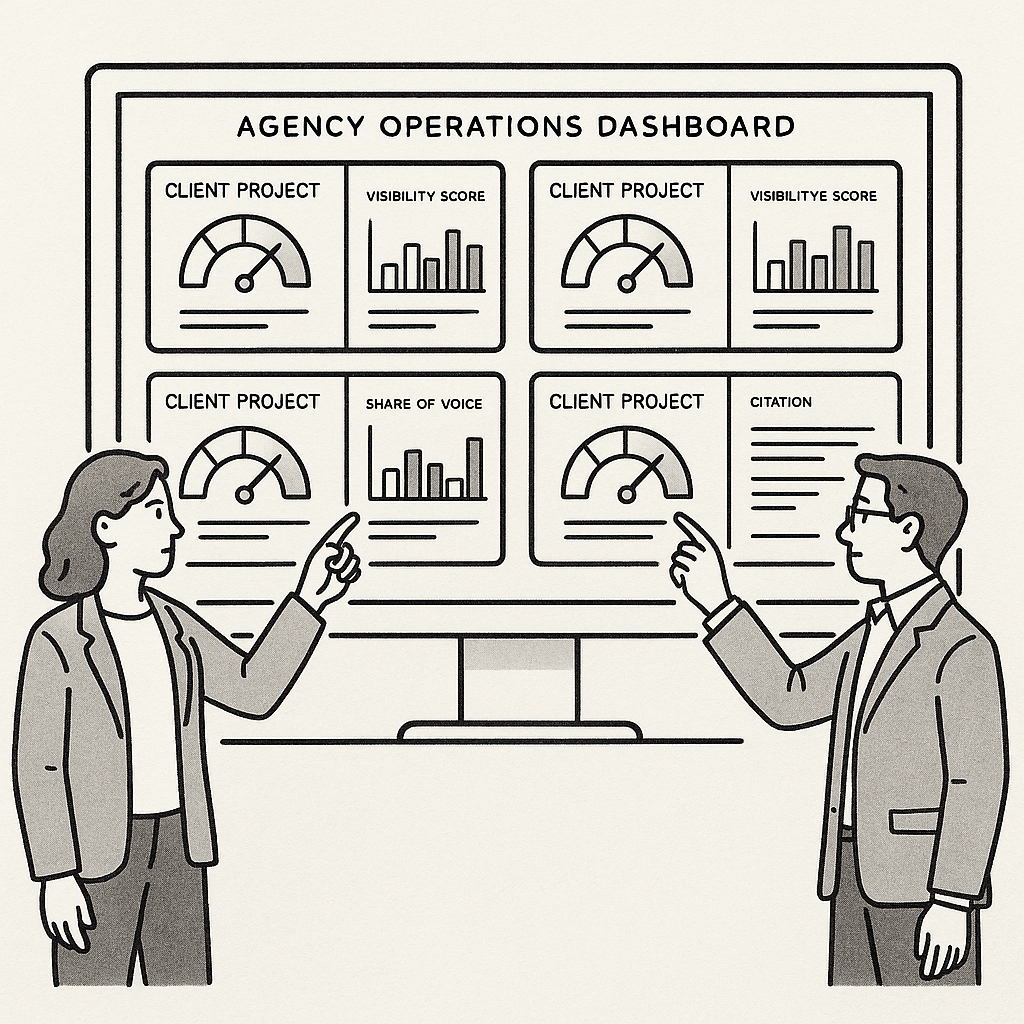
AI Search Visibility for Agencies: Why the Service Model Decides Who Wins
Gartner predicted that traditional search engine volume would fall roughly 25% by 2026 as buyers shift to AI chatbots and virtual agents (Gartner press release, February 2024). The shift is already measurable: Comscore data reported by Search Engine Land shows AI Overviews appearing in 39.4% of U.S. desktop searches in June 2026, up from 25.8% in July 2025 (Search Engine Land). This guide sets out a repeatable operating model for ai search visibility for agencies running 25 or more accounts.
The binding constraint is not tooling. Most agencies can produce a credible AI visibility audit for one client; few can deliver identical quality across 10, 25, or 50 accounts without rebuilding the process each time. The seven moves below — productize the offer, build per-client prompt sets, standardize the measurement cadence, template reporting, assign strategist and analyst ownership, price the service, and review quarterly — turn one-off audits into a service line.
Alef supplies the infrastructure: an AI visibility engine tracking mentions, citations, rankings, sentiment, and competitor share of voice across ChatGPT, Perplexity, Gemini, Copilot, and AI Overviews, with projects that keep each client domain and market organized. Expect intermediate skill level; prerequisites are client domain access and a defined competitor list per account. Initial build-out runs roughly one working day per client for the first three accounts, then drops sharply once templates exist. For traditional Google and Bing rank tracking, see the multi-client SEO performance tracking guide; for the engine itself, explore Alef's AI visibility platform.
When an Agency Needs a Dedicated AI Visibility Service Line
Most agencies do not decide to launch an AI visibility offer on a quiet Tuesday. The service line gets forced into existence by a pattern of client conversations that traditional rank reports cannot resolve. Five triggers recur across agency rosters.
- Prospects ask why ChatGPT does not recommend them. The question arrives in a sales call, and a rankings dashboard has no answer for it. Explaining the mechanics of why a brand stays invisible in AI answers is now part of the pitch.
- AI Overviews already sit on the queries clients care about most. As of September 2026, Suff Digital recorded AI Overviews on 57.6% of U.S. commercial searches on desktop and 61.2% on mobile. Commercial intent is no longer a safe zone.
- AI-referred traffic appears in analytics with no owner. Sessions from ChatGPT and Perplexity show up in referral reports, yet no one is accountable for the channel or reporting on it. Defining what AI-referred traffic is and how to measure it becomes a prerequisite for any credible client conversation.
- Account teams run ad-hoc ChatGPT checks in browser tabs. No history, no prompt versioning, no evidence that a client's position changed between quarters.
- The roster crosses roughly 8-10 accounts. At that point, per-client manual checks stop fitting into a working month, and the agency either builds a system or quietly drops the work.
The cost of delay is not neutral. Answer engines draw from a narrow pool of repeatedly cited sources, so early citations compound while competitors accumulate them.
The 10-Step Multi-Client Operating Model
The ten steps below form a closed loop: each one produces an artifact the next step consumes, from the tier sheet that anchors the sales conversation to the quarterly review that resets the prompt set. The sequence is deliberate. Agencies that begin with tooling tend to end up with dashboards nobody bills for; agencies that begin with the offer structure end up with a service line that holds its margin at 30 accounts and beyond.
Step 1 — Productize the offer into three tiers and define deliverables before selling
AI visibility work fails commercially when it is sold as an open-ended consulting engagement. The fix is a three-tier ladder in which every tier has a named deliverable, a fixed hour budget, and a defined cadence. The table below is the structure Alef recommends agencies adopt as their starting point; the hour ranges reflect what a competent analyst and strategist pair can sustain without renegotiating scope mid-quarter.
| Tier | Core deliverables | Setup hours | Monthly hours | Cadence |
|---|---|---|---|---|
| AI Visibility Audit (one-time) | 40–60 prompt baseline, citation gap analysis, competitor share of voice snapshot, prioritized action memo | 12–18 | — | One delivery, 3-week turnaround |
| Monitoring Retainer | Prompt set tracking across ChatGPT, Gemini, Perplexity; monthly three-page report; quarterly strategy call | 6–10 | 3–5 | Weekly runs, monthly report |
| AEO Execution Retainer | Everything in monitoring plus answer-ready content briefs, schema implementation, digital PR against cited sources | 10–14 | 12–20 | Weekly runs, monthly report, monthly execution sprint |
Two pricing realities shape this ladder. First, the audit is the sales instrument, not the profit center — it should be priced to close (typically a low four-figure fee) and credited against the first retainer month. Second, the execution retainer is where margin lives, but only if the content and schema work is scoped against a finite queue rather than "ongoing optimization." Soar Agency's 2026 survey of AI visibility agency pricing documents how widely agencies currently price comparable scopes, which is precisely why a fixed deliverable sheet outperforms hourly quoting in the sales conversation.
The verification point for Step 1 is simple: if two people on the team cannot independently quote the same tier at the same price using the sheet, the offer is not yet productized.
Step 2 — Draw the service scope boundary in writing
Scope creep in AI visibility work arrives through a predictable door: the client asks why a competitor was cited instead of them, and the account manager promises to "fix it." Guaranteed citations are not a deliverable any agency can honestly sell, because answer engines select sources through retrieval and ranking processes the agency does not control.
A written boundary clause prevents this. What sits inside scope:
- Prompt set design and quarterly refresh
- Citation gap analysis identifying which third-party sources engines cite for target prompts
- Answer-ready content briefs mapped to specific prompts and cited sources
- Schema markup recommendations and implementation support
- Monthly reporting and the strategist call
What sits outside scope, stated explicitly in the SOW:
- Guaranteed inclusion in any AI answer or citation
- Changes to how a model weights its training data
- Management of review platforms, directories, or communities the client does not own
- Real-time monitoring or on-demand prompt runs beyond the contracted cadence
The boundary also protects the analyst. When a client forwards a screenshot of a ChatGPT answer at 9 p.m. asking why the brand is missing, the contract already answers the question: the next scheduled run will capture it, and the monthly report will address it. Without that clause, every screenshot becomes an unscoped work order.
Step 3 — Build a per-client prompt set of 30 to 60 buyer questions
The prompt set is the measurement instrument, and its quality determines whether every downstream number means anything. Each client needs between 30 and 60 prompts, constructed as real buyer questions rather than keyword strings, grouped by topic and tagged by intent.
Three intent classes structure the set:
- Discovery prompts — "What tools help a mid-market retailer track AI search visibility?" These test whether the brand appears when the buyer does not yet know the category players.
- Comparison prompts — "How does [client] compare to [competitor A] and [competitor B]?" These test positioning and whether the brand is named in head-to-head answers.
- Buying prompts — "What is the best [category] platform for a 200-person company?" These test commercial proximity, where a citation is worth the most.
Each prompt also carries two tags: market (region or vertical) and audience (role or company size). A B2B client selling to both enterprise and SMB segments needs prompts tagged separately, because engines answer those two audiences differently and the aggregate score masks the split.
This is where Alef's prompt intelligence workspace does the structural work: it runs structured buyer questions through ChatGPT, Gemini, and Perplexity and measures brand mentions, ranking position within the answer, and the sources cited, while its prompt view groups the set by topic, intent, and audience so the strategist can see which intent class is underperforming rather than staring at a single blended score. For agencies, the practical gain is consistency — every client's prompt set follows the same taxonomy, so cross-client reporting uses one vocabulary.
The verification test: a new analyst should be able to read the prompt set and correctly predict which intent class each prompt belongs to without asking.
Step 4 — Establish the baseline across every enabled engine
The baseline run is the audit artifact and the anchor for every future comparison. It requires running the full prompt set across every enabled engine in a single window — not spread over two weeks — and recording five metrics per prompt:
- Mention rate: the percentage of prompts where the brand appears at all
- Average position: where the brand sits in the answer's ordering when mentioned
- Citation count: how often the client's own domain is cited as a source
- Sentiment: whether the mention is neutral, favorable, or carries a qualification ("X is popular but expensive")
- Competitor share of voice: the same four metrics applied to three to five named competitors
Save the raw answer text for every prompt. This is the detail most agencies skip and later regret. The raw history is what lets a strategist show a client the exact sentence an engine produced in January versus April, which is far more persuasive than a line chart. It also protects the agency when a client disputes a score — the underlying answer is on file.
The baseline should be delivered as a standalone document, not folded into the first monthly report. It is the reference point that makes month two legible, and clients who receive it as a distinct artifact treat the subsequent reports as progress rather than noise.
Step 5 — Standardize the measurement cadence
Inconsistent run schedules invalidate month-over-month comparisons, because answer engines change their retrieval behavior continuously. If January's runs happen on the 3rd and February's on the 19th, any movement in the data is confounded by the calendar.
The cadence that holds across a roster:
- Weekly automated runs for all monitoring and execution clients, on a fixed day, across a fixed engine list
- Monthly analysis and reporting, compiled from the four or five weekly runs in that month
- Quarterly strategic review, where the prompt set itself is revised
Two rules make the cadence defensible. First, the run day is contractual — pick Tuesday and keep Tuesday, because it removes the question of whether a spike is real or a scheduling artifact. Second, the engine list is fixed within a quarter. When a new engine is added to the roster's tracking, it enters at a quarter boundary and its first month is treated as a baseline, not compared against prior months.
The verification point: any two monthly reports for the same client should be directly comparable without a footnote explaining a methodology change. If a footnote is needed, the cadence broke.
Step 6 — Template the reporting into a fixed three-page structure
Reporting is where multi-client AI visibility work either scales or collapses into bespoke deck-building. A fixed template solves it. Three pages, every client, every month:
| Page | Contents | Data source |
|---|---|---|
| 1. Visibility score and trend | Blended visibility score, 90-day trend line, movement by intent class | Weekly run aggregates |
| 2. Share of voice and citations | Brand versus named competitors; top 10 cited sources with client presence flagged | Citation data per prompt |
| 3. Action queue | Prioritized list of 5–8 actions with owner and expected impact | Strategist interpretation |
Page three is the one clients actually read, and it should never contain more than eight items — a longer queue signals the strategist has not prioritized. Each action names the prompt it targets, the source gap it addresses, and the owner.
White-labeling is a template setting, not a design project: the client's logo, the agency's color, and a fixed cover page. Alef's guide to building an AI search visibility report walks through the metric definitions and page structure in more depth, including how to phrase the share-of-voice comparison so clients read it as a competitive position rather than a grade.
The verification test: producing a monthly report for an existing client should take under 90 minutes, of which at most 45 are strategist interpretation. If it takes a day, the template is not fixed.
Step 7 — Assign ownership between strategist and analyst
Ambiguous ownership is the most common cause of multi-client delivery failure, and it rarely surfaces as an error — it surfaces as drift, where prompt sets go unrefreshed for two quarters and nobody notices the dashboard is tracking stale questions.
The split is clean:
The analyst owns the instrument. Prompt hygiene (deduplication, taxonomy consistency, retirement of prompts that no longer match the client's business), run schedules and engine configuration, data QA before any report ships, and dashboard accuracy. The analyst is accountable for the question "is this number correct?"
The strategist owns the meaning. Interpretation of movement, the prioritized action queue, the client conversation, and the quarterly prompt set revision. The strategist is accountable for the question "what should the client do about this number?"
At 25 accounts, one analyst and two strategists is a workable ratio; the analyst's load scales with run volume, which is predictable, while the strategists' load scales with client meetings, which is not. The handoff point is a QA checkpoint: no report reaches a strategist until the analyst has signed off on the data, and no report reaches a client until the strategist has written page three. Both names appear on the report.
Step 8 — Convert gaps into an execution queue
For every prompt where the client is absent or ranked low, the question is not "how do we get mentioned?" but "which sources did the engine cite, and can the client earn a presence there?" The citation data answers it directly. If an engine cites three review sites and two industry publications for a comparison prompt, the execution queue is built against those five sources.
The queue converts into three work types:
- Content briefs for answer-ready pages that target the prompt's underlying question, structured so an engine can extract a direct answer
- Schema work that makes the client's entity relationships machine-readable, particularly for comparison and buying prompts where the engine needs to disambiguate the brand from competitors
- Digital PR aimed at the specific third-party sources the engines actually cite, not at generic link acquisition
This is where AI visibility work diverges from traditional SEO execution. A link from a high-authority domain that no answer engine cites for the client's prompts has near-zero value to the visibility score. The queue is therefore source-first, not domain-authority-first, and it is rebuilt each month from that month's citation data.
The verification point: every item in the action queue should trace back to a specific prompt and a specific cited source. Items that cannot make that trace belong in a general SEO roadmap, not the AI visibility queue.
Step 9 — Price the service against delivery hours and review margin per client
Pricing discipline is what separates a service line from a series of favors. With hours defined in Step 1 and the queue bounded in Step 8, each client's margin becomes calculable: contracted monthly fee minus (analyst hours plus strategist hours multiplied by loaded cost).
Three pricing rules keep the roster healthy:
- The audit is priced to convert, with the fee credited against the first retainer month
- The monitoring retainer carries a floor that covers the analyst's run and QA time even at zero strategist involvement
- Execution retainers are scoped in queue items, not hours — a fixed number of briefs, schema implementations, and outreach targets per month
Review margin at the account level every quarter. A client whose strategist hours have crept 40% above plan because the action queue keeps expanding is a repricing conversation, not a service failure. The scope boundary from Step 2 is the reference document in that conversation.
Step 10 — Run the quarterly review and reset the prompt set
The quarterly review closes the loop and prevents the measurement instrument from going stale. Three things happen in it:
- Prompt set revision. Retire prompts the client's business has moved past, add prompts for new products or markets, and re-tag where audience definitions have shifted. A prompt set that has not changed in twelve months is measuring last year's buyer.
- Tier reassessment. Clients who have saturated the monitoring tier's value are candidates for the execution retainer; clients whose queue consistently clears early are candidates for a lighter tier.
- Competitive re-baselining. If a new competitor has entered the client's answer set, they join the share-of-voice tracking from the next quarter's baseline.
The quarterly review is also the moment to revisit the engine list. The answer-engine landscape is moving fast enough that the composition of AI-generated results shifts measurably within a year — Comscore data reported by Search Engine Land put Google AI Overviews in 39% of U.S. desktop searches, and separate analysis from Suff Digital found AI answers on 57.6% of commercial searches, while Gartner projects a 25% drop in traditional search engine volume by 2026. A roster tracking only one engine is measuring a shrinking slice of the buyer's actual research path.
The verification point for the full model: at the end of a quarter, every client on the roster should have a current prompt set, four or more weekly run cycles, three monthly reports, one strategic review, and an action queue that traces to citations. When all five are present across 30 accounts, the operating model is running — and the next constraint is capacity, not process.
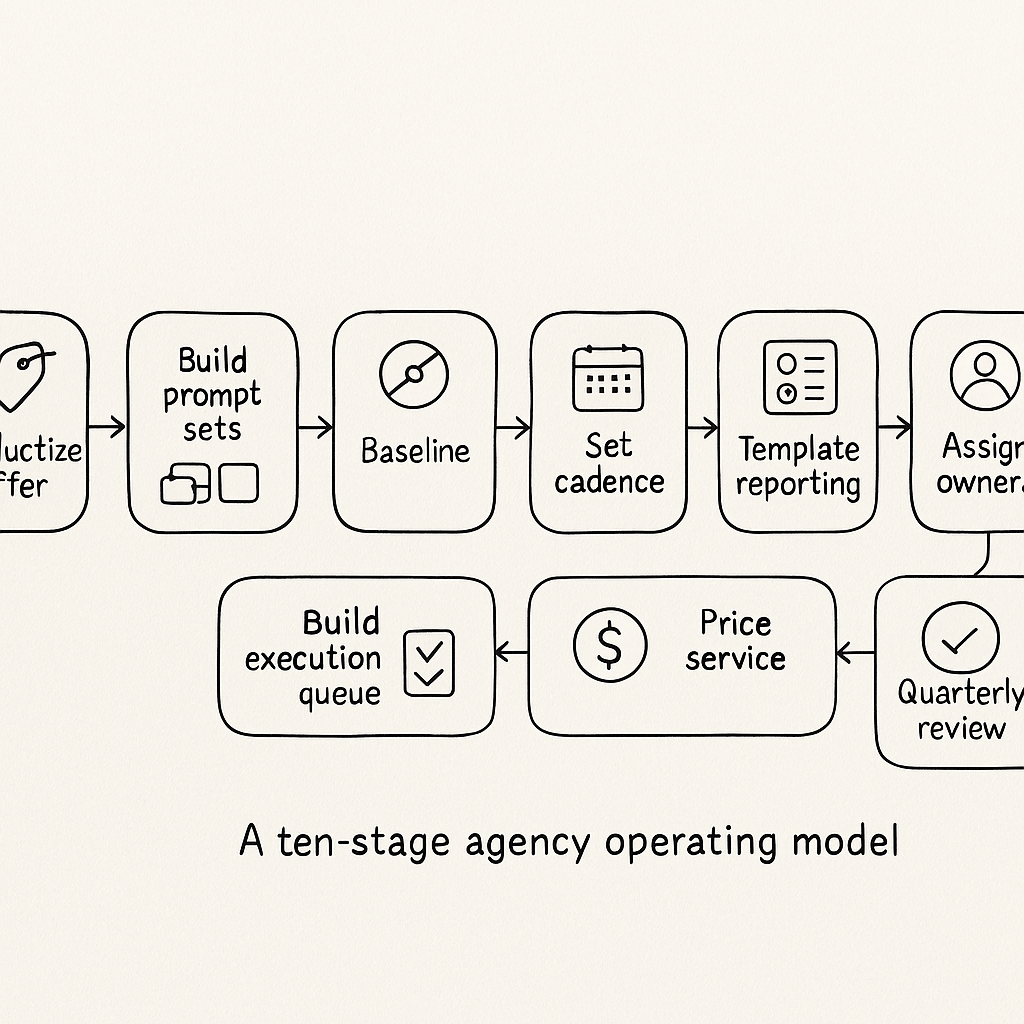
Common Mistakes That Break Multi-Client AI Visibility Delivery
The operating model fails in predictable ways. Most breakdowns trace back to a handful of process errors that compound across a roster, and each has a defined fix.
Where Multi-Client Delivery Breaks Down
Reusing one prompt set across every client is the most common failure. Category language differs by vertical and market, so a shared list measures the agency's assumptions rather than the client's actual demand. Each account needs its own prompt set built from its own category vocabulary.
Changing the engine list or run cadence mid-quarter invalidates trend lines and makes the visibility score indefensible in a client meeting. Lock both for the full quarter and log any change with a dated note.
Reporting mentions without citations hides the actionable signal. A brand can be named without being linked, and the citation is what shows which source to fix; tracking AI citations separately from brand mentions makes that distinction visible in every report.
Letting the analyst also own client strategy stalls the action queue, because data QA and interpretation compete for the same hours. Split the roles and hold the boundary.
Selling AI visibility as a guarantee of citations overpromises. Answer engines reshuffle source pools without notice, so the sellable unit is measurement and execution, not placement.
Skipping a baseline before execution removes the proof of improvement. Save a pre-work snapshot of the AI visibility metrics that predict pipeline before the first optimization ships.
Pre-Flight Checklist
- Separate prompt sets per client. Build each from the account's own vertical and market language.
- Frozen engine list and cadence. Hold both steady for the quarter and date every change.
- Citations logged alongside mentions. Capture the linking source, not just the brand name.
- Strategist and analyst split. Keep interpretation and data QA in different hands.
- Outcome framed as measurement. Promise tracking and execution, never guaranteed placement.
- Baseline saved before work begins. Snapshot the starting score so gains are provable.
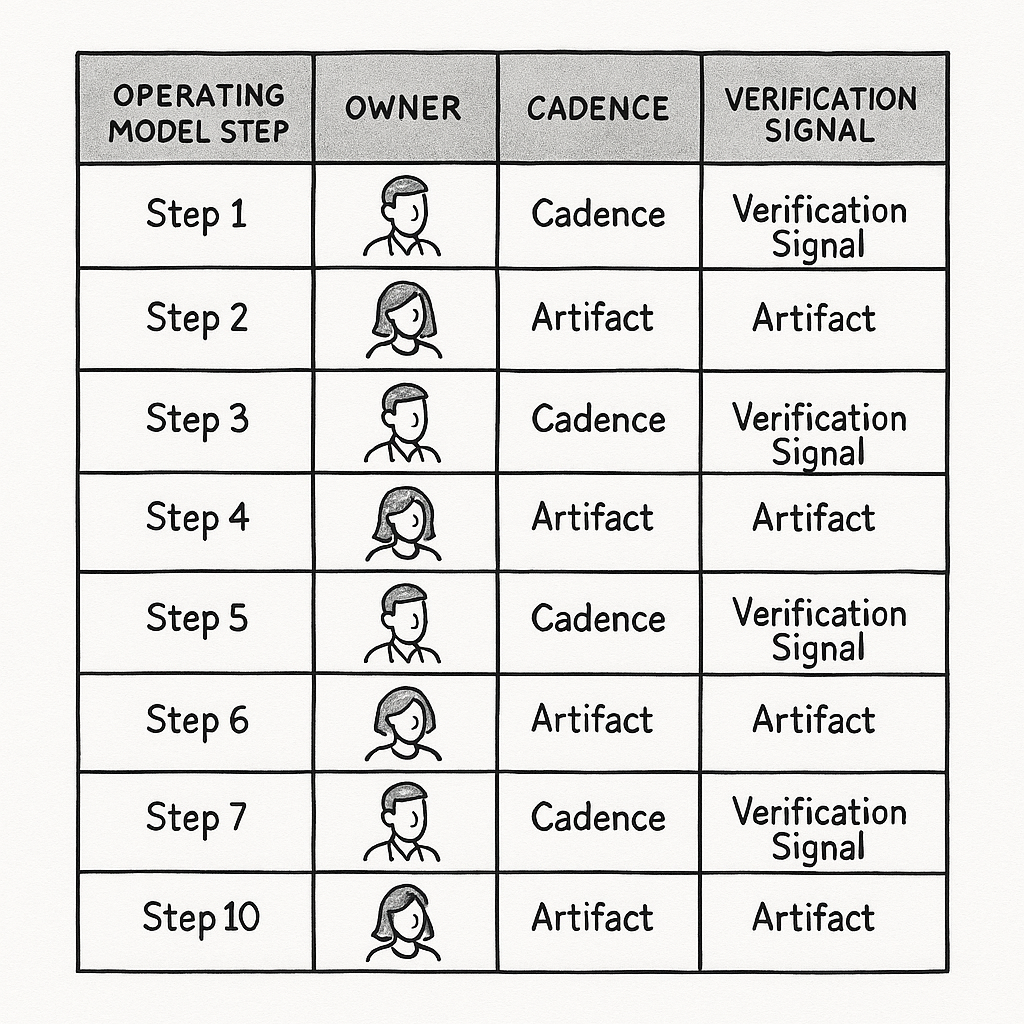
Summary Table: Steps, Owners, Cadence, and Verification
The ten steps of the operating model collapse into a single reference grid. Each row names the accountable role, the recurring rhythm, the artifact that proves the work happened, and the signal that confirms it landed.
| Step | Primary owner | Cadence | Tool or artifact | Verification signal |
|---|---|---|---|---|
| 1. Productize the offer | Agency principal | Once, then annual refresh | Service one-pager with scope tiers | Three named tiers with fixed deliverables and prices |
| 2. Build per-client prompt sets | Analyst | Monthly build, quarterly rebuild | Prompt set in Alef project | 30–60 prompts live and tagged by intent |
| 3. Standardize measurement cadence | Analyst | Weekly pull, monthly rollup | Alef tracking schedule | Every client has a run on the same weekday |
| 4. Template the reporting | Strategist | Monthly | Report template with fixed sections | Client-ready deck in under 60 minutes |
| 5. Assign strategist/analyst ownership | Agency principal | Once, reviewed quarterly | RACI sheet per account | No account with an unassigned owner |
| 6. Price the service | Agency principal | Annual | Rate card benchmarked to market | Retainers inside the $1,500–$10,000/month agency range (Soar Agency) |
| 7. Instrument AI-referred traffic | Analyst | Monthly | Analytics segment for AI referrers | Referrer segment reporting non-zero sessions |
| 8. Close citation gaps | Strategist | Monthly | Gap list mapped to content briefs | Each gap has an owner and a due date |
| 9. Run the client review | Strategist | Monthly | Standing 30-minute agenda | Share-of-answer delta presented with source |
| 10. Review quarterly | Strategist and analyst | Quarterly | Re-audit trigger at 10-point share drop | Prompt set rebuilt when the trigger fires |
Teams selecting the tracking layer beneath this model can compare feature sets in Alef's breakdown of AI SEO tools and the features that actually matter. The table doubles as an onboarding checklist: any blank cell marks a gap in delivery, not a gap in documentation.
Standalone use: Screenshot rows 1–10 as the agency's delivery contract. The pricing range and the 10-point re-audit trigger make the grid defensible in a client conversation without additional context.
Key Takeaways for Agency AI Visibility Delivery
Key takeaways - Productize the offer before selling it: fixed prompt sets, fixed cadence, fixed deliverables. - Baseline every client's prompt set before promising movement; the baseline is the contract. - Assign strategist and analyst ownership per account so measurement never depends on heroics. - Template reporting once and reuse it across the roster; per-client decks do not scale. - Price against the delivery model, not the tool seat, and revisit the model quarterly.
The differentiator is the operating model, not the dashboard. Alef supplies the multi-project workspace, prompt tracking, and citation data that make the model repeatable across 25 or more accounts — but the sequence still matters: productize, baseline, set cadence, template reporting, then price. Skipping ahead breaks the chain. And because answer engines now shape a growing share of commercial queries, as data on AI Overview coverage suggests (Search Engine Land), the distinction between AEO and traditional SEO belongs in every client conversation.
Frequently Asked Questions About AI Search Visibility for Agencies
How much should an agency charge for AI visibility services?
Published market pricing for agency AI visibility services in 2026 runs from roughly $3,000 to $30,000+ per month for ongoing retainers, with one-time audits landing between $1,500 and $7,500 depending on scope (Soar Agency). The defensible way to set a number inside that band is a cost-plus model: per-client platform seat cost, plus analyst hours for prompt maintenance and citation review, plus strategist hours for interpretation and client communication, multiplied by the agency's standard margin. A 30-prompt account that consumes four analyst hours and one strategist hour monthly prices very differently from a 60-prompt account spanning three markets and two languages. Build the quote from those inputs rather than anchoring to a competitor's rate card.
How many prompts should each client have tracked?
Thirty to sixty tracked prompts is the working range for a single-market client, grouped by topic cluster and intent type rather than collected as a flat list. Below 30, the sample is too thin to distinguish real movement from answer-engine noise; above 60, analyst review time grows faster than insight. For small retainers, a floor of 15 to 20 prompts concentrated on the highest-commercial-intent queries keeps the service viable without diluting coverage.
How often should AI visibility be monitored?
Weekly automated runs, monthly human analysis, and a quarterly strategy review is the cadence that holds up across a roster. Answer engines recompile source pools on their own schedules, so daily polling mostly produces variance that analysts then have to explain away. Consistency matters more than frequency: a client compared against the same prompt set, same engines, and same run day each week has a trend line; a client measured ad hoc does not.
Can AI visibility be white-labeled for clients?
Yes, and it should be. Clients should see their own brand, their competitors, and their citation coverage inside a report carrying the agency's identity — not a third-party dashboard login that exposes the agency's stack and invites the client to price it independently. Branded PDF exports and scheduled email summaries cover most reporting needs; shared live access is a premium tier, not the default.
What is the difference between AI visibility tracking and traditional rank tracking?
Traditional rank tracking measures a page's position in a list of ten blue links; AI visibility tracking measures whether a brand is mentioned, cited, and described accurately inside a synthesized answer that may draw on sources the client does not rank for at all. The two require different prompt sets, different success metrics, and different reporting. A fuller breakdown of where the methodologies diverge sits in this comparison of AI visibility tracking versus traditional rank tracking.
How long before clients see movement in AI answers?
There is no fixed timeline, because answer engines refresh their source pools on their own schedules and give no change notifications. The practical answer is to report leading indicators first: citation coverage (is the client's domain appearing among cited sources for target prompts), source presence in retrieval, and accuracy of brand descriptions. Mention rate follows those signals, often by weeks. Setting that expectation at onboarding prevents the month-two "nothing is happening" conversation — and a structured evaluation of an AI SEO platform before committing to a vendor makes those indicators measurable from day one.
Why this matters for the operating model: every question above resolves to the same requirement — a workspace where each client's prompt set, citation data, and reporting history live in isolation but run on one cadence. That is the infrastructure layer the ten steps depend on.
Build the Operating Model on Alef
Alef organizes every client domain and market as a separate project, so the same operating model holds whether the roster spans 3 accounts or 30. Each project carries its own prompt set, baseline run, and citation data, while the Knowledge Base stores per-client brand context so outputs stay consistent across strategists and analysts. The next step is concrete: start a free trial or book a walkthrough at Alef's AI visibility platform and stand up a first client project with a defined prompt set and a baseline measurement run. The objective is a repeatable service line with defensible reporting, not another dashboard login.
Sources
- Gartner: Predicts Search Engine Volume Will Drop 25% by 2026, Due to AI Chatbots and Other Virtual Agents
- Search Engine Land: Google AI Overviews now appear in 39% of U.S. desktop searches (Comscore)
- Suff Digital: Google Now Shows an AI Answer on 57.6% of Commercial Searches
- Soar Agency: AI visibility agency pricing in 2026
- Search Engine Land: What 1 million keywords reveal about AI's impact on search
Turn this article into a visibility plan
Use Alef to audit your site, find content gaps, and create briefs your team can ship.