AI Visibility Explained: How AI Crawlers Find, Cite, and Send Traffic to Your Site
AI visibility determines whether ChatGPT, Perplexity, and AI Overviews cite your pages. Learn how AI crawlers index content and how AI-referred traffic differs.
Intro
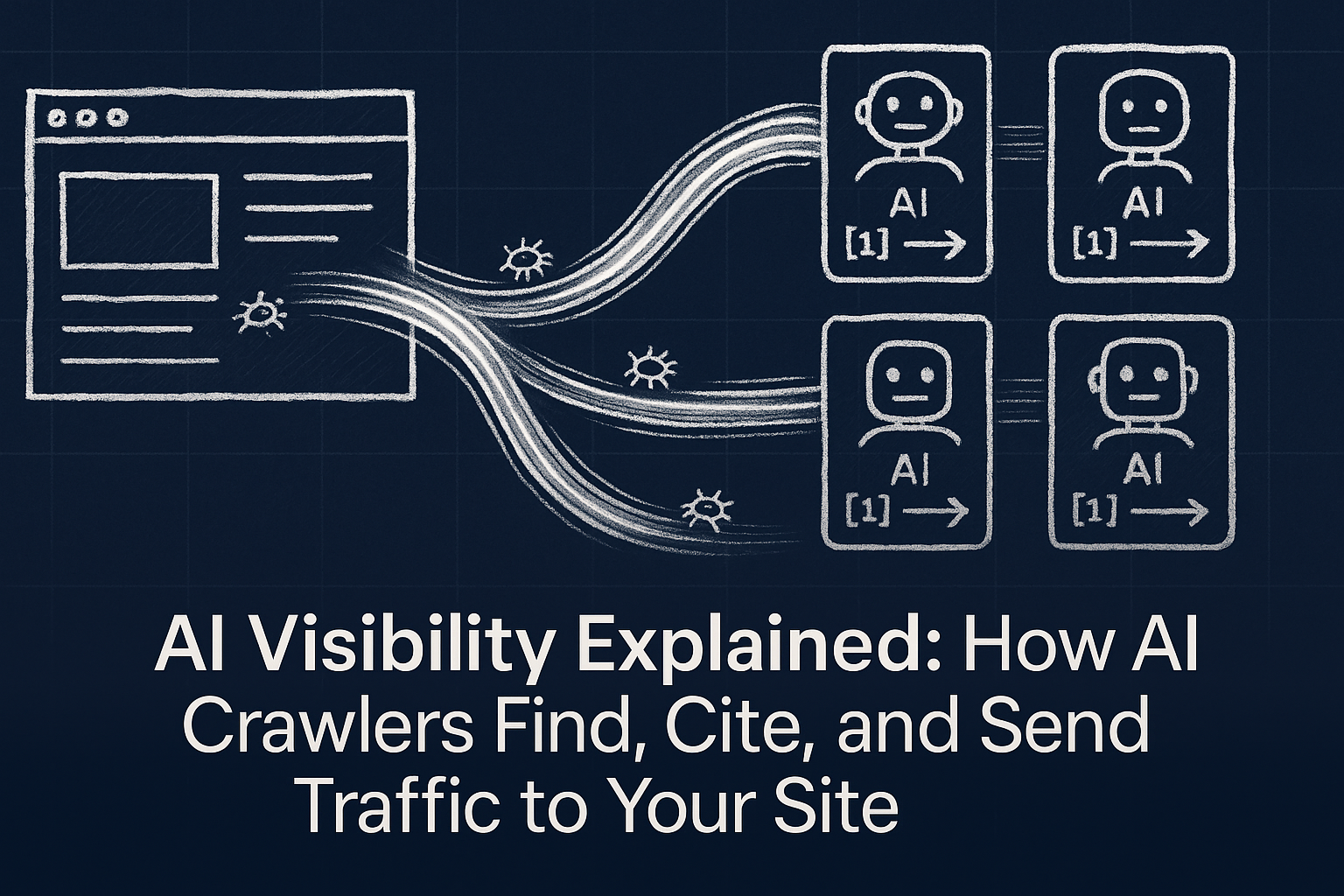
AI visibility is the degree to which a website is discovered, retrieved, and cited by AI search engines and assistants when someone asks a question in its category. The mechanics behind it are already measurable: across a 55-day sample of 24 million proxy requests on 69 websites, ChatGPT's retrieval crawler issued roughly 3.6 times more requests than Googlebot, according to Search Engine Journal's crawl-data analysis. AI systems now read the web more aggressively than the search engine most sites optimize for.
That raises a pointed question. If an AI assistant answered a buyer's question about this category today, would the site be named, cited, or missing entirely? A page that ranks in Google can still be absent from AI answers, because retrieval, synthesis, and citation are separate steps from ranking.
Alef is the AI visibility engine built for that gap. It tracks mentions, citations, rankings, and competitors across ChatGPT, Perplexity, Gemini, Copilot, and Google AI Overviews, then connects those signals to content creation, site health, and backlink work. This article defines the concept, walks through the ten-step path from crawl to citation, explains why it matters alongside traditional SEO, and closes with a worked example and FAQs. For the underlying retrieval mechanics, see what AI answer engine optimization involves; to see how Alef measures them, explore its AI visibility solution.
What Is AI Visibility?
AI visibility is the degree to which a website's content is discovered by AI crawlers, retrieved and synthesized into AI-generated answers, and cited with a link or brand mention across answer engines such as ChatGPT, Perplexity, Gemini, Copilot, and Google AI Overviews.
That definition rests on three layers. Discoverability depends on crawl access and indexation: whether GPTBot, ChatGPT-User, and Googlebot can reach a page and whether its content enters the index at all. Extractability asks whether a model can lift a clean, self-contained answer from the page. Citability asks whether the model trusts the source enough to name it.
Why a Ranking Is Not a Citation
A position-3 blue link and a citation inside a synthesized answer are different outcomes produced by different retrieval paths, even when they share the same underlying index. The distinction between AEO and SEO explains why a page can rank well and still go uncited.
Why AI Visibility Resists a Single Rank
AI answers vary by model, prompt phrasing, and date, so visibility is tracked as a recurring sample of prompts rather than one fixed position. The metrics worth watching are set out in this guide to AI search visibility versus Google rankings.
One Discipline, Many Names
Readers will meet AEO, GEO, LLM optimization, and AI search optimization. All four describe work on the same three layers.
How AI Visibility Works: 10 Steps from Crawl to Citation
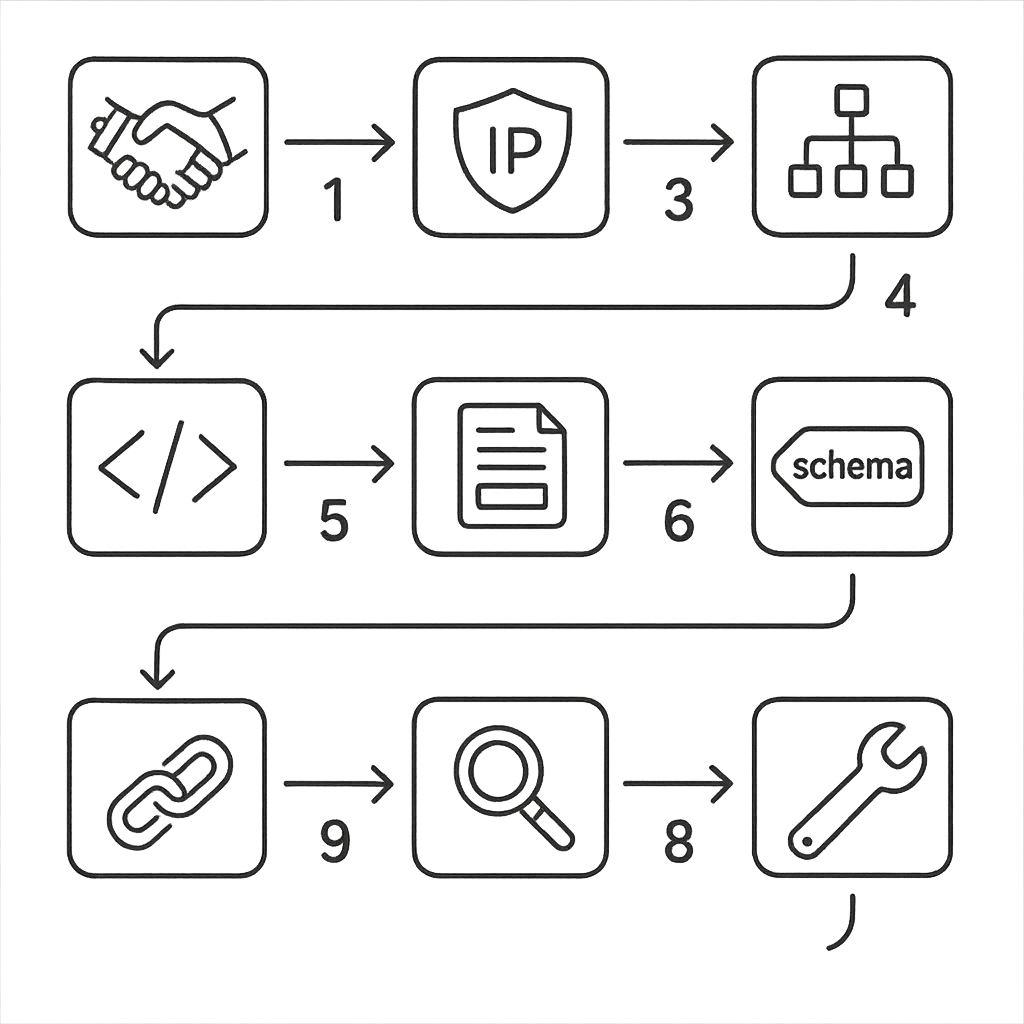
AI visibility is not a single ranking event but a pipeline: a crawler must be permitted to fetch a page, the page must render and parse cleanly, the model must be able to extract a clear claim, and independent sources must corroborate that claim before an answer engine cites it. Each stage can fail silently. The ten steps below trace that pipeline in order, from the robots.txt directive that decides whether an AI agent is allowed in at all to the prompt-level tracking that reveals whether the citation actually happened.
The Ten Steps
- Allow the AI crawlers that matter for each surface. GPTBot and ChatGPT-User are distinct agents with distinct robots.txt tokens: GPTBot handles training-side collection, while ChatGPT-User signals a live retrieval request triggered by a user's question. Blocking one does not block the other, and the same logic applies across PerplexityBot, ClaudeBot, and Googlebot, each of which powers a different answer surface. The practical risk is accidental exclusion. Cloudflare's July 2025 shift to blocking AI crawlers by default means a large share of sites are now opted out of AI retrieval without anyone making an explicit decision, which is why an audit of robots.txt and CDN-level bot rules belongs at the top of any AI search optimization program. A useful breakdown of how each agent behaves and what it collects is available in this analysis of AI crawlers and their SEO impact.
- Verify crawler identity against published IP ranges. User-agent strings are trivially spoofable, so a log entry claiming to be GPTBot proves nothing on its own. OpenAI publishes its crawler IP ranges in a machine-readable file, gptbot.json, containing the CIDR blocks its agents actually use; log analysis should match source IPs against those ranges rather than trusting the UA string. The same discipline applies to other engines that publish verification endpoints. Without IP validation, traffic reports conflate genuine AI-referred requests with scrapers impersonating them, and the resulting data misleads every downstream decision.
- Keep the crawl path clean. Discovery depends on a navigable structure: an XML sitemap at sitemap.xml, internal links that reach every revenue page within a few clicks of the homepage, no orphaned URLs, and no accidental noindex tags or canonical errors pointing elsewhere. AI crawlers operate under tighter crawl budgets than Googlebot in many configurations, so wasted fetches on redirect chains and duplicate URLs cost proportionally more. A sitemap that lists stale or redirected URLs is worse than no sitemap, because it teaches the crawler to distrust the file.
- Make pages renderable without JavaScript. Crawlers and retrieval systems that cannot execute client-side rendering see only the empty shell of a JavaScript-heavy page: the template loads, the content does not. Server-rendered HTML or a prerendering layer keeps the text available at fetch time, which matters because extraction happens on what the crawler actually receives, not on what a browser would eventually paint. Sites that migrated to client-side frameworks without SSR often discover their best content is invisible to AI agents while remaining fully indexed by Google, a gap that rarely surfaces in standard SEO reporting.
- Structure content for extraction. An answer engine lifts passages, not pages, so each section should open with a direct answer to the question its heading poses. One idea per section, descriptive H2 and H3 headings phrased the way buyers actually ask the question, short declarative sentences, and tables or lists for comparative facts all increase the odds that a specific passage is selected verbatim. This is the core discipline of optimizing content for AI search engines, and it overlaps heavily with long-standing featured-snippet best practice.
- Publish the entity facts models need to resolve the brand. A model citing a page must first know who is being described. Consistent brand name, product category, location, and pricing language across the site give it stable anchors, reinforced by Organization, Product, Article, and FAQPage structured data that state those facts in a parseable format. Inconsistent naming, a category described three different ways on three pages, or pricing that appears only inside images all create ambiguity, and ambiguous entities are cited less often than clearly defined ones.
- Earn third-party corroboration through backlinks and mentions. Retrieval systems weigh independent evidence heavily: a claim repeated only on the brand's own domain is a marketing statement, while the same claim appearing on reputable, non-competing sites reads as consensus. Citations cluster around sources that multiple pages agree on, which is why backlink building remains a direct AI visibility lever rather than a legacy SEO task. Digital PR placements, industry directories, and expert commentary all function as corroboration signals, provided the linking sites are themselves trustworthy.
- Track the prompts, not just the keywords. Keyword rank tracking measures position on a results page; AI visibility requires running the actual buyer questions through each engine on a schedule and recording four things: whether the brand is named, whether its URL is cited, which competitors appear in the same answer, and which sources the answer leans on. That last field is the most actionable, because it reveals exactly which third-party pages a model trusts for a given topic, and therefore where corroboration efforts should concentrate.
- Measure AI-referred traffic separately from organic search. Sessions arriving from ChatGPT, Perplexity, and similar surfaces land with distinct referrers or none at all, and they behave differently: typically fewer pages per session and a narrower, more research-driven intent. Isolating AI-referred traffic in analytics prevents it from being absorbed into "direct" or blended with organic, and it makes the business case for the preceding eight steps measurable. The volume is no longer marginal; Search Engine Journal has reported that ChatGPT now crawls roughly 3.6 times more than Googlebot, a signal of how much retrieval activity now runs outside traditional search.
- Close the loop by feeding findings back into content. Each tracking cycle produces a list of prompts where the brand is absent, prompts where a competitor is cited instead, and sources the model favors. Those findings should route directly into the content pipeline: new answer-first sections for uncovered questions, updated entity facts where the model describes the brand inaccurately, and outreach targets where corroboration is thin. AI visibility compounds only when measurement and production are connected; run as separate workstreams, the tracking data accumulates without changing what the site publishes.
Key takeaway: Every step in this pipeline is a permission or a clarity problem before it is a ranking problem. Crawlers must be allowed in, pages must render, entities must be unambiguous, and claims must be corroborated elsewhere. Fixing any single step in isolation produces little movement; the gains come from the chain operating end to end.
Why AI Visibility Matters Alongside Traditional SEO
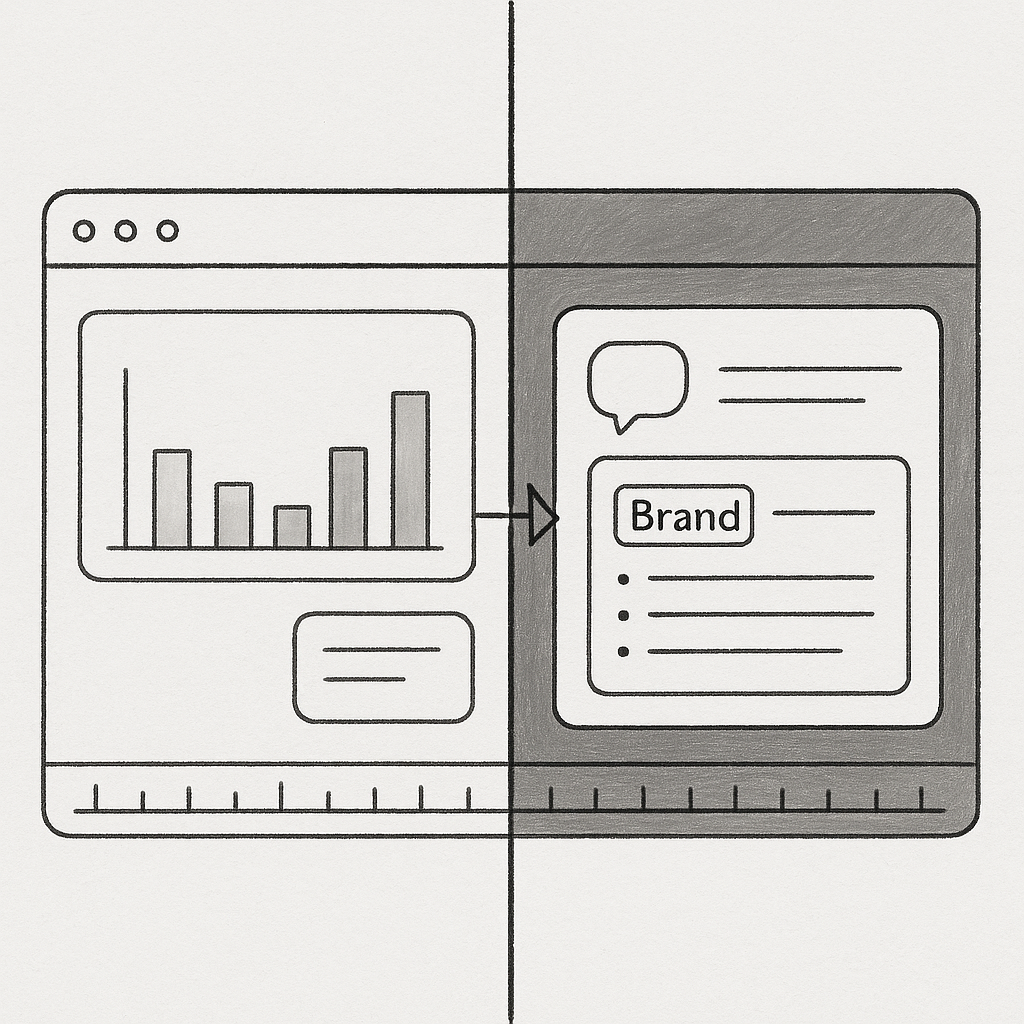
The stakes are easiest to see in click behavior. Pew Research Center found that Google users clicked a traditional result in roughly 8% of visits when an AI summary appeared, versus 15% without one, and clicked a link inside the summary in only about 1% of visits (Pew Research Center). Being cited therefore matters even when clicks are thin.
- Traffic is rerouting, not vanishing. Google states its AI search features send billions of clicks to websites each week (Google Search Central). The channel rewards cited sources rather than penalizing every site equally.
- The research phase happens inside the answer. Buyers shortlist vendors from AI responses before visiting any site, so absence from the answer removes a brand from consideration before the click stage.
- Mentions without links still move buyers. Alef's research on tracking AI citations and unlinked brand mentions documents that a large share of AI brand mentions carry no link, making brand-level visibility a separate asset from referral sessions.
- Traditional SEO remains the substrate. Crawl access, indexation, page speed, and backlinks still determine what retrieval systems can find. AI visibility extends SEO discipline rather than replacing it.
AI-referred traffic behaves differently enough to warrant its own measurement model, which is why defining and measuring AI-referred traffic belongs beside classic organic reporting.
Practical Example: A 90-Day AI Visibility Baseline for a Mid-Size B2B Site
A concrete scenario makes the mechanics tangible. Consider a B2B software company with 240 indexable pages, 40 tracked buyer prompts, and no AI-specific tracking in place. In its baseline month, 6 of 40 prompts named the brand and just 2 prompts cited its URLs. The gap between being named and being cited is the entire problem in miniature.
Diagnosing the Crawl Layer First
The audit surfaced a single-line defect: robots.txt allowed GPTBot but blocked ChatGPT-User, the agent that performs live retrieval. Training crawls succeeded; retrieval could not read the site at all. OpenAI's crawler documentation distinguishes the two user agents, and the fix was one line. Given that ChatGPT's crawler now requests pages at volumes far exceeding Googlebot's (Search Engine Journal), a blocked retrieval path is a silent ceiling on AI visibility.
Fixing Answer Readiness on the Twelve Highest-Intent Pages
The team added answer-first opening paragraphs, converted three comparison pages into tables, applied FAQPage markup to pages with existing visible FAQ sections, and repaired two canonical errors flagged in a site health audit. Each change made content easier to extract as a standalone answer.
Building Corroboration
Fifteen earned links and brand mentions landed on industry publications and partner sites over the quarter, aimed at the pages where prompts already surfaced competitors. Third-party corroboration gives retrieval systems independent reason to trust the source.
Re-Measuring on the Same 40 Prompts
Brand named in 19 of 40 prompts; cited URLs in 11. AI-referred sessions were then separated from direct traffic using the metrics that predict pipeline.
| Step | Starting Value | Ending Value | Proving Metric |
|---|---|---|---|
| Crawl access | ChatGPT-User blocked in robots.txt | ChatGPT-User allowed | Retrieval requests logged in server logs |
| Answer-first openings | 0 of 12 pages | 12 of 12 pages | Extractable lead paragraph present |
| Comparison pages as tables | 0 of 3 | 3 of 3 | Structured table markup validated |
| FAQPage markup | 0 pages | 6 pages | Rich-result eligibility confirmed |
| Canonical errors | 2 | 0 | Audit error count |
| Earned links and mentions | 0 | 15 | Referring-domain count |
| Prompts naming brand | 6 of 40 | 19 of 40 | Prompt-tracking log |
| Prompts citing URLs | 2 of 40 | 11 of 40 | Citation-tracking log |
| AI-referred sessions | Unsegmented | Segmented channel | Analytics referral classification |
Conclusion
AI visibility is not a single optimization but a chain: crawl access, clean indexation, extractable structure, entity clarity, third-party corroboration, prompt-level tracking, and separate measurement of AI-referred traffic. Each link strengthens the next, and a weak link anywhere in the sequence caps the whole system.
The central distinction bears repeating. Ranking and being cited are different outcomes, and a site can hold a strong Google position while remaining entirely absent from AI answers. The levers that close that gap are familiar SEO levers applied with more precision: content, rankings, backlinks, and enhanced search results. For teams weighing whether existing work carries over, the honest answer is that it compounds rather than resets.
Key takeaways - Crawl access comes first: confirm GPTBot and other AI crawlers are permitted in robots.txt before optimizing anything else. - Answer-first structure makes pages extractable, so key claims survive being lifted into a generated response. - Citation is not ranking; a page can rank well and still never be quoted. - Prompt-level tracking reveals which real questions a brand appears in, not just which keywords it ranks for. - AI-referred traffic deserves its own segment, because it behaves differently from organic search visits.
Where a site has done the work and still sees nothing in AI answers, the diagnostic path is usually structural rather than editorial — a blocked crawler, thin entity signals, or missing corroboration. Alef's AI visibility solutions treat those causes as one connected system, and the breakdown of why a brand stays invisible in AI answers covers the most common failure points in detail.
Frequently Asked Questions
What is AI visibility in simple terms?
AI visibility is how often and how prominently a brand appears in AI-generated answers, whether that answer is assembled by ChatGPT, Perplexity, Google AI Overviews, or another assistant. It rests on three layers: whether AI crawlers can reach and parse the page, whether the content is structured so a model can extract a clean, self-contained claim, and whether enough corroborating sources exist for the model to trust that claim. A site can pass the first layer and still fail the second, which is why crawlability alone never guarantees citation.
Do I need a separate strategy for AI search optimization?
No separate strategy is required, but a separate measurement layer is. The same crawl access, substantive content, and backlink authority that earn traditional rankings feed AI answers, because retrieval systems draw on indexed pages that already rank or are otherwise well-corroborated. What changes is instrumentation: prompt tracking across assistants and segmentation of AI-referred traffic sit on top of existing SEO reporting rather than replacing it. Teams that treat AI visibility tracking as an added lens on the same content program avoid duplicating work.
Which AI crawlers should I allow in robots.txt?
The retrieval and training crawlers worth reviewing by name are GPTBot and ChatGPT-User (OpenAI), PerplexityBot, ClaudeBot, and Googlebot. Blocking training-only crawlers is a legitimate business decision about content reuse, but blocking retrieval crawlers removes the site from live answers entirely. OpenAI documents the distinction between its crawlers in its crawler overview, and crawl volume is not trivial: ChatGPT's crawler now fetches pages at roughly 3.6 times the rate of Googlebot, according to Search Engine Journal's crawl analysis.
How long does it take to see AI visibility improve?
Crawl and indexation fixes can register within days to weeks, while citation gains depend on re-crawl cadence and third-party corroboration, so teams should measure monthly rather than daily. Models refresh their retrieval indexes on their own schedules, and a new claim needs independent sources echoing it before assistants repeat it consistently. Daily dashboards mostly capture noise; monthly trend lines show whether the content is being picked up. The mechanics of earning those mentions are covered in how to get cited by ChatGPT.
Does llms.txt help with AI visibility?
llms.txt is an unratified community proposal, and there is no public evidence that major model providers routinely consume it. It functions as a curated map of a site's most useful pages for any agent that chooses to read it, which makes it harmless housekeeping, but it is not a ranking lever and should not displace sitemap.xml or clean HTML structure. Treat it as documentation, not optimization.
How is AI-referred traffic different from organic search traffic?
AI-referred traffic arrives from a cited link inside a synthesized answer, often without a clean referrer, and typically with more context already established than a blue-link click. The visitor has usually read a summary that names the brand, so the landing page inherits warmer intent but a narrower question. Pew Research Center found Google users are less likely to click links when an AI summary appears, which makes each AI-referred visit more deliberate and worth tracking as its own channel.
Grow Your AI Visibility with Alef
AI visibility rewards sites that treat crawlability, extractability, and citability as one connected system rather than a separate AI-only tactic. Alef is built around that premise: it converts the ten-step chain from crawl to citation into a single workflow spanning SEO-optimized content creation, search ranking tracking, backlink building, and search result enhancement.
The surfaces are deliberately connected. AI Visibility tracking monitors mentions, citations, rankings, and competitors; Prompt Intelligence groups the buyer questions that matter by topic and intent; Site Health surfaces crawl, indexability, and answer-readiness fixes; and Content Growth turns the resulting gaps into briefs and articles. Because ChatGPT already crawls far more aggressively than Googlebot (Search Engine Journal), that crawl-to-citation chain leaves little room for disconnected tooling.
The next step is deliberately small: start with a single domain and run a visibility check to see where AI currently finds the brand. The free-start AI visibility path shows what that first check covers, and the full platform is available at alef.ink.
Sources
- Search Engine Journal — ChatGPT Now Crawls 3.6x More Than Googlebot
- Pew Research Center — Google users are less likely to click on links when an AI summary appears
- Google Search Central — AI Features and Your Website
- OpenAI — Overview of OpenAI Crawlers (GPTBot and ChatGPT-User)
- Cloudflare — Cloudflare Just Changed How AI Crawlers Scrape the Internet at Large
- Search Engine Land — Google says AI Search features send billions of clicks to websites each week
- llms.txt — FAQ and proposal status
- Schema.org — Structured Data Vocabulary
Turn this article into a visibility plan
Use Alef to audit your site, find content gaps, and create briefs your team can ship.