Answer Engine Optimization: The Complete Guide to Earning AI Citations in ChatGPT, Perplexity and Google AI Overviews in 2026
Answer engine optimization gets your pages retrieved and quoted by AI answers. A five-step process for B2B SaaS teams, plus the metrics that prove it worked.
Intro
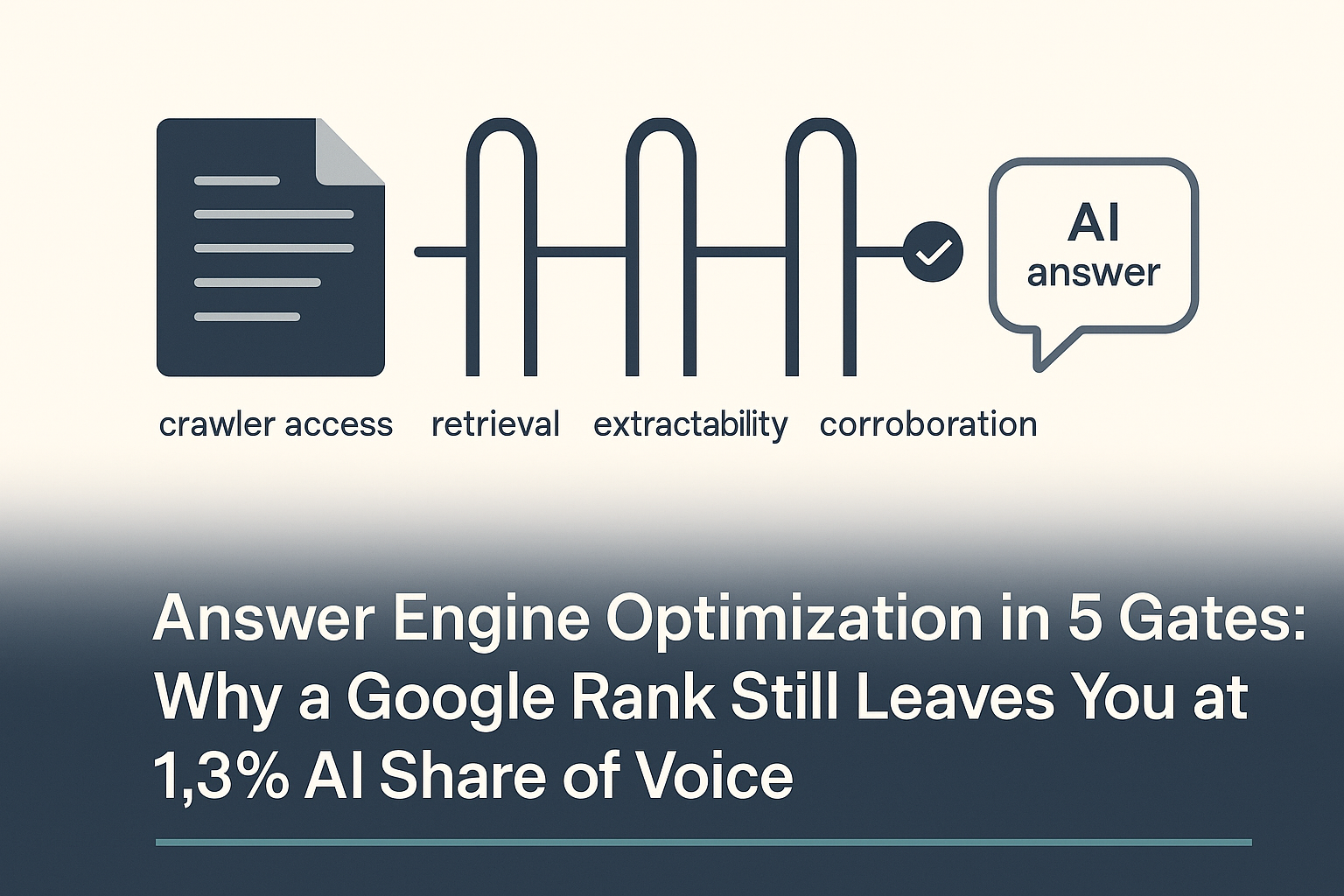
Pew Research Center found that users click a traditional result in only about 8% of Google visits when an AI summary appears, versus nearly 15% when it does not — the click is no longer the unit of visibility (Pew Research Center). Answer engine optimization is the practice of structuring content so AI answer engines retrieve it, extract it, and quote it — not merely rank it. Alef ranks in Google, yet its own domain holds a 1.3% share of voice in AI answers against SEMrush at 5.2%, Surfer SEO at 5.1% and Ahrefs at 4.6%, with an AI visibility score of 10.2. Google rank does not equal AI citation. A page earns that citation only by passing four gates in sequence — crawler access, retrieval, extractability, corroboration — shown in the diagram below. Alef, an AI visibility engine that tracks mentions, citations, rankings and competitors across the questions buyers actually ask, reports these share-of-voice figures from its own measurement rather than asserting them; the AI visibility platform overview explains how that tracking works. What follows is the shortest useful process for in-house SEO leads and agency strategists at B2B SaaS companies: five steps, one measurement loop.
When you need it
Answer engine optimization becomes urgent under four conditions, and most B2B SaaS teams hit at least one without noticing.
- Buyers already ask AI for shortlists. If prospects query ChatGPT, Perplexity, Gemini or Copilot for vendor comparisons and competitors are named while the brand is absent, the buying journey is happening without you.
- Page-one rankings, third-party citations. The domain ranks for commercial queries, yet AI answers quote listicles, review sites and analyst pages instead of your own. Pew Research Center found Google users are less likely to click links when an AI summary appears, so the citation itself carries the click.
- A recent migration, redesign or robots.txt change. A blocked GPTBot, ClaudeBot or OAI-SearchBot is the most common silent failure; OpenAI's crawler documentation and Anthropic's crawler guidance define exactly which user agents to allow.
- A new category with no corroboration. Retrieval has nothing to reinforce, which is the pattern behind most cases of a brand invisible in AI answers.
Prerequisites: a crawlable site, robots.txt and server-log access, a fixed competitor set of three to five brands, and one owner for a weekly prompt check. The first pass runs as a one-day audit plus a two-week content sprint, with no engineering ticket beyond robots.txt and schema deployment; a site health check confirms crawler access before the sprint starts.
Steps
The five steps below run in sequence because each one gates the next: a page that fails crawler access is never retrieved, a page that is retrieved but not extractable is never quoted, and a page that is extractable but uncorroborated is rarely preferred over a source the wider web already agrees with. Alef's own domain illustrates why the sequence matters. It ranks in Google for its core terms yet holds a 1.3% share of voice in AI answers, against SEMrush at 5.2%, Surfer SEO at 5.1% and Ahrefs at 4.6% — first-party data from Alef's visibility tracking. Rank is not the constraint. Gate compliance is.
1. Allow the crawlers
Before any content work, audit robots.txt for the user agents that actually feed answer engines. Four matter most for B2B SaaS: GPTBot, OAI-SearchBot, PerplexityBot and ClaudeBot. OpenAI documents each token separately and notes that blocking GPTBot does not affect OAI-SearchBot visibility — the two serve different functions, and a site can opt out of one without losing the other (OpenAI crawler documentation). Anthropic confirms its bots honor standard robots.txt directives, so a blanket Disallow: / written years ago silently removes a site from Claude's retrieval path (Anthropic Help Center).
The audit itself is short. Pull the live robots.txt, search for each token by name, and check whether any wildcard rule (User-agent: *) disallows the paths that hold commercial content — pricing pages, comparison pages, glossary entries. Many SaaS sites block /pricing or /compare to keep them out of classic indexation, which also removes them from AI retrieval. Where a page must stay unindexed in Google but remain citable by answer engines, use page-level noindex rather than a robots block; noindex is a Google directive, not a crawler-access directive.
Verification: server logs should show 200 responses to requests from each bot's user agent string within the crawl window. If a bot appears in logs with a 403 or never appears at all, the gate is closed regardless of what the content says.
2. Map buyer prompts, not keywords
Keyword research answers what people type into a search box. Prompt mapping answers what they ask an assistant when they are mid-evaluation. Build a set of 30 to 50 prompts across four intents that map to the B2B buying journey:
- Alternatives — "what are alternatives to [category leader]", "tools like [competitor] for [use case]"
- Comparisons — "[your brand] vs [competitor]", "[competitor A] or [competitor B] for [segment]"
- Pricing — "[product] pricing", "how much does [category] software cost per seat"
- How-to — "how to set up [task]", "how to measure [metric] without [tool]"
Group the prompts by topic and intent so gaps become visible per stage. A set that is heavy on how-to and empty on comparisons tells a team its content serves top-of-funnel research but never appears in the shortlist conversations where deals are decided.
Alef's Prompt Tracker turns this from a spreadsheet into a monitored set: it runs structured buyer questions through ChatGPT, Gemini and Perplexity to measure brand visibility, mentions and source citations, so the prompt list stays current as assistants re-rank their answers. The same workflow is documented in Alef's guide to getting cited by ChatGPT.
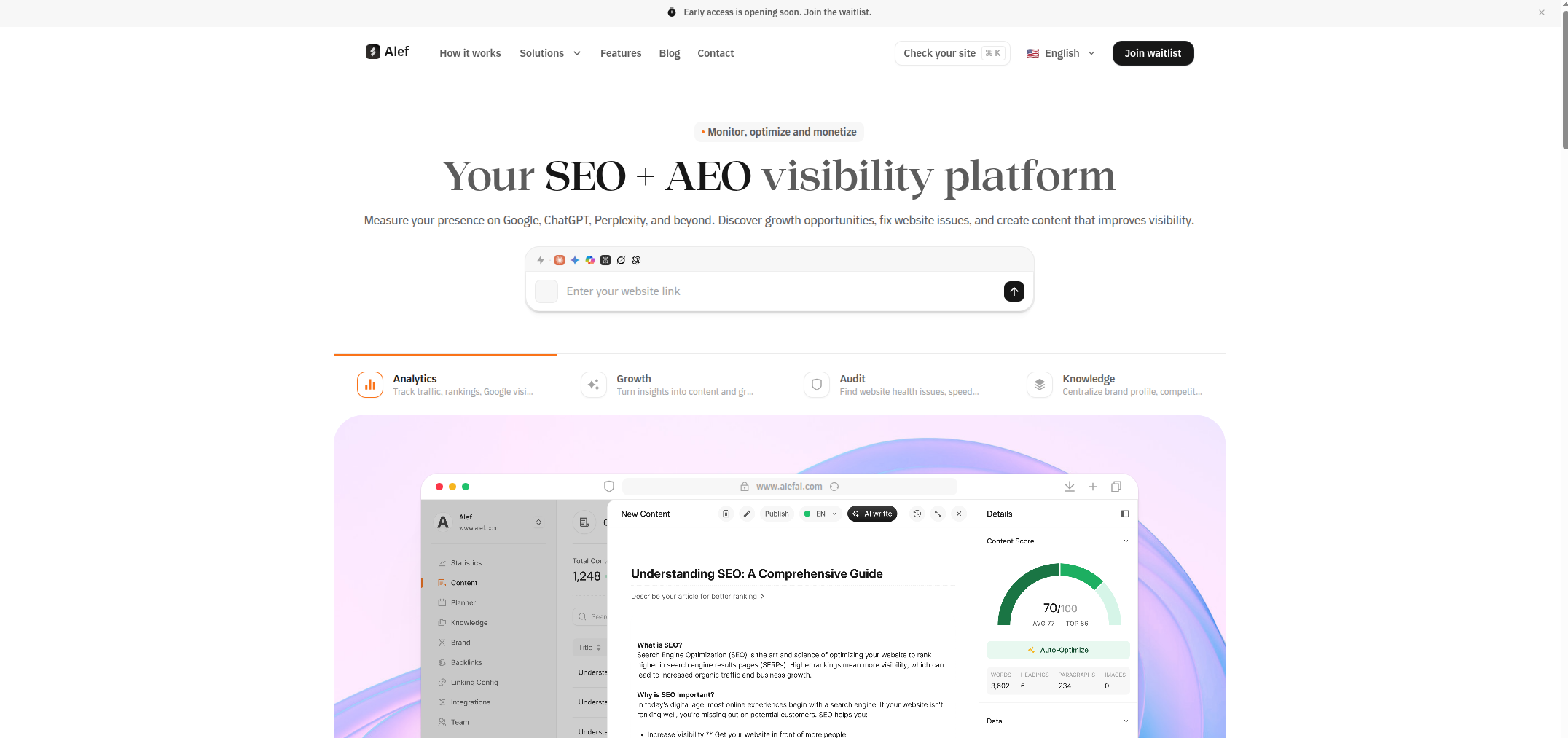
Verification: every prompt in the set is logged with its intent tag, the assistant tested, and the current cited sources. A prompt with no recorded citation baseline cannot be measured later.
3. Write answer-shaped sections
Retrieval systems lift passages, not pages. A section that buries its answer under three sentences of context is a section that gets skipped. The fix is structural: put the buyer's question in the H2 or H3 verbatim, then answer it in the first two sentences, before any caveats, history or qualification.
One question per section. No preamble. If a heading reads "What does answer engine optimization cost?", the next sentence should be a number or a range, not "In order to understand pricing, we first need to consider…". The same discipline applies to comparison sections — lead with the verdict, then justify it.
This matters more as AI summaries absorb clicks. Pew Research Center found that Google users are less likely to click on links when an AI summary appears in the results (Pew Research Center), which raises the value of being the quoted source rather than the clicked destination. A page optimized for the click alone optimizes for a shrinking surface.
Verification: read the first two sentences of every section in isolation. If they do not answer the heading's question without further context, rewrite them.
4. Make it extractable
Extractability is a formatting problem with a schema layer on top. Four rules cover most of it:
- Lead with a definition. Glossary and concept pages should open with a one-sentence definition in the form "[Term] is [category] that [distinguishing function]." This is the passage an assistant quotes when asked what something means.
- Use numbered steps for processes. Ordered lists signal sequence to both readers and parsers; prose paragraphs describing a process get summarized loosely or skipped.
- Keep one comparison table per page. A single GFM table with a real header row and concrete values in every cell is the most quotable structure on a B2B page. Two tables on one page compete for the same extraction slot.
- Deploy schema where it is genuinely true.
DefinedTermfor glossary entries (schema.org/DefinedTerm), plusArticleandFAQPagewhere the page actually contains an article body or a real FAQ. Marking up content that is not on the page is a fast route to being ignored.
Google's guidance on AI features confirms that standard indexing and structured data remain the foundation for how content surfaces in AI experiences (Google Search Central). There is no separate AI schema; there is only clean, machine-legible structure.
Verification: run the page through a schema validator and confirm zero errors. Then check that each table cell holds a value — no "varies", no "depends", no em dashes standing in for data.
5. Earn third-party corroboration
This is the gate most B2B SaaS teams skip, and it is the one that decides close calls. Retrieval favors sources the wider web already agrees with. A fact stated only on a vendor's own domain reads as a claim; the same fact repeated on a listicle, a review platform, an analyst page and a partner's documentation reads as consensus.
The work is unglamorous and specific. Identify the three to five facts that most distinguish the product — pricing model, integration count, compliance posture, category definition — and get them repeated accurately off-site. That means pitching inclusion in category listicles, keeping review-platform profiles current, supplying analyst briefings with citable figures, and giving partners documentation that restates the same numbers. Inconsistency across those sources is worse than absence: a price that reads $49 on the site and $39 on a review platform gives an assistant reason to hedge or to cite the other source.
Verification: search each core fact as a prompt in two assistants and confirm the cited sources include at least one domain that is not owned by the brand. A fact with zero third-party citations has not passed this gate, no matter how well it is formatted on-site.
The sequence is not optional
Teams that start at step 3 — rewriting headings into questions — see no movement when step 1 is blocking the crawler or step 5 has never been attempted. The order exists because each gate filters the pages that reach the next one. A page that clears all five is citable; a page that clears four is a near miss that reads, in share-of-voice terms, exactly like a page that was never written.
Common mistakes
Most failed answer engine optimization programs break at the same six points. Each is preventable, and each has a specific fix.
- Blocking the training crawler and calling it a strategy. Disallowing GPTBot in robots.txt opts a site out of model training, not out of search eligibility, because OAI-SearchBot is a separate token with its own access rules (OpenAI crawler documentation). The avoidance: audit each user agent individually before writing a single Disallow line, and treat AI crawler access and its SEO impact as a per-bot decision rather than a blanket policy.
- Optimizing for keywords instead of prompts. A keyword list never reveals which comparison, pricing or how-to question the brand currently loses, so the content never targets the answer that matters. The avoidance: build the prompt map first and assign each prompt to a page.
- Burying the answer under a preamble. Three sentences of context before the actual answer give an extraction model nothing clean to quote. The avoidance: state the answer in the first two sentences beneath the question heading.
- Publishing structure the parser cannot read. Answers locked inside images, accordions or long unbroken paragraphs break extractability even when the prose itself is strong. The avoidance: keep critical answers in plain HTML text, tables and numbered lists.
- Skipping corroboration. A perfect page with no third-party repetition loses retrieval to a weaker page the wider web already cites. The avoidance: seed the same facts into listicles, review pages and analyst write-ups.
- Reporting rank as a proxy for AI visibility. Alef's own domain holds a 1.3% share of voice in AI answers against SEMrush at 5.2%, which shows a Google position can coexist with near-invisibility in answers. The avoidance: report share of answer alongside rank, as the AEO versus SEO distinction makes explicit.
Summary table
The five gates and the measurement loop condense into one operating sheet. Each row is a discrete task with a pass/fail signal, so a team can run the sequence without re-reading the full process. The effort estimates assume one in-house SEO lead and an existing sitemap; the content work compounds once the content growth workflow is templated across pages.
| Step | Gate it clears | Concrete action | Verification signal | Typical first-pass effort |
|---|---|---|---|---|
| 1. Allow the crawlers | Crawler access | Add explicit allow rules in robots.txt for GPTBot, OAI-SearchBot, ChatGPT-User and ClaudeBot, per OpenAI's crawler documentation and Anthropic's crawl guidance | Server logs show 200 responses to each user agent; zero 403s | 1–2 hours |
| 2. Map buyer prompts | Retrieval | Build 30–50 prompts across four intents: alternatives, comparisons, pricing, how-to | Prompt set documented and assigned to matching URLs | 1–2 days |
| 3. Write answer-shaped sections | Extractability | Question as the H2, direct answer in the first two sentences | Answer appears verbatim in a manual AI query | 3–5 days |
| 4. Make it extractable | Extractability | One comparison table plus DefinedTerm or Article schema | Schema validates; table renders in plain text | 4–8 hours |
| 5. Earn corroboration | Corroboration | Secure 3–5 third-party pages repeating the same facts | Independent pages cite the same figures | 2–6 weeks |
| 6. Measure share of answer | Measurement loop | Weekly prompt checks; monthly share-of-voice review against a fixed competitor set | Visibility score and share of voice trend upward | 2 hours weekly |
The verification column matters more than the effort column: a step is only complete when its signal is observable, not when the task is marked done.
Conclusion
Citations are gated, not ranked. Crawler access precedes retrieval, extractability decides which sentences an answer engine can lift verbatim, and third-party corroboration determines whose version of a fact gets trusted. Alef's own data illustrates the consequence: a domain can rank in Google and still hold 1.3% AI share of voice while SEMrush captures 5.2%. The measurement therefore shifts from position to share of answer visibility score and citation gaps tracked against a fixed competitor set. For teams reconciling the two signals, AI search visibility versus Google rankings: what to track sets out the reporting model.
Key takeaways - Citations are gated, not ranked: pass crawler access, retrieval, extractability and corroboration in sequence. - Access precedes retrieval — blocked AI crawlers mean zero citations regardless of content quality. - Extractability decides what gets quoted; corroboration decides who gets trusted. - Share of answer, visibility score and citation gaps replace position as the primary signal.
Frequently asked questions
What is answer engine optimization in simple terms?
Answer engine optimization is the practice of structuring content so AI answer engines can retrieve it and quote it directly, rather than merely ranking it in a list of links. The distinction matters because retrieval and ranking reward different signals: a page can hold position one on Google and still be absent from the synthesized answer above it, since the engine selects passages it can lift cleanly and attribute. Alef's own domain illustrates the gap — it ranks in Google yet holds a 1.3% share of voice in AI answers against SEMrush at 5.2%. The answer engine optimization fundamentals explain how retrieval differs from ranking in practice.
Does answer engine optimization replace SEO?
No. Crawlability and indexation remain the first gate, so AEO sits on top of technical SEO rather than around it. If GPTBot or OAI-SearchBot cannot fetch a page, no amount of answer-shaped formatting will earn a citation, and blocked or noindexed pages are invisible to retrieval regardless of their Google position. The work compounds: clean XML sitemaps, server-side rendering and stable URLs serve both channels, while passage-level structure and third-party corroboration serve the answer layer specifically.
How long does it take to see AI citations?
Access and extractability fixes can surface within weeks of a recrawl, because they depend only on the publisher's own site. Corroboration takes longer, since it requires third parties listicles, review platforms, analyst pages — to publish and repeat the same facts, and that timeline is outside the publisher's control. Expect the first movement in citation frequency after one to two recrawl cycles, and reserve months for share-of-voice gains against an established competitor set.
Which AI crawlers should be allowed in robots.txt?
GPTBot, OAI-SearchBot, PerplexityBot and ClaudeBot should each be reviewed individually, because every one is a separate user-agent token. Blocking one does not block the others, and OpenAI documents distinct roles for its crawlers — GPTBot for model training, OAI-SearchBot for search indexing — so a site can permit retrieval while restricting training if policy requires it (OpenAI crawler documentation). Anthropic publishes equivalent guidance for its own crawler (Anthropic Help Center), and the same token-by-token audit applies.
How is AI visibility measured?
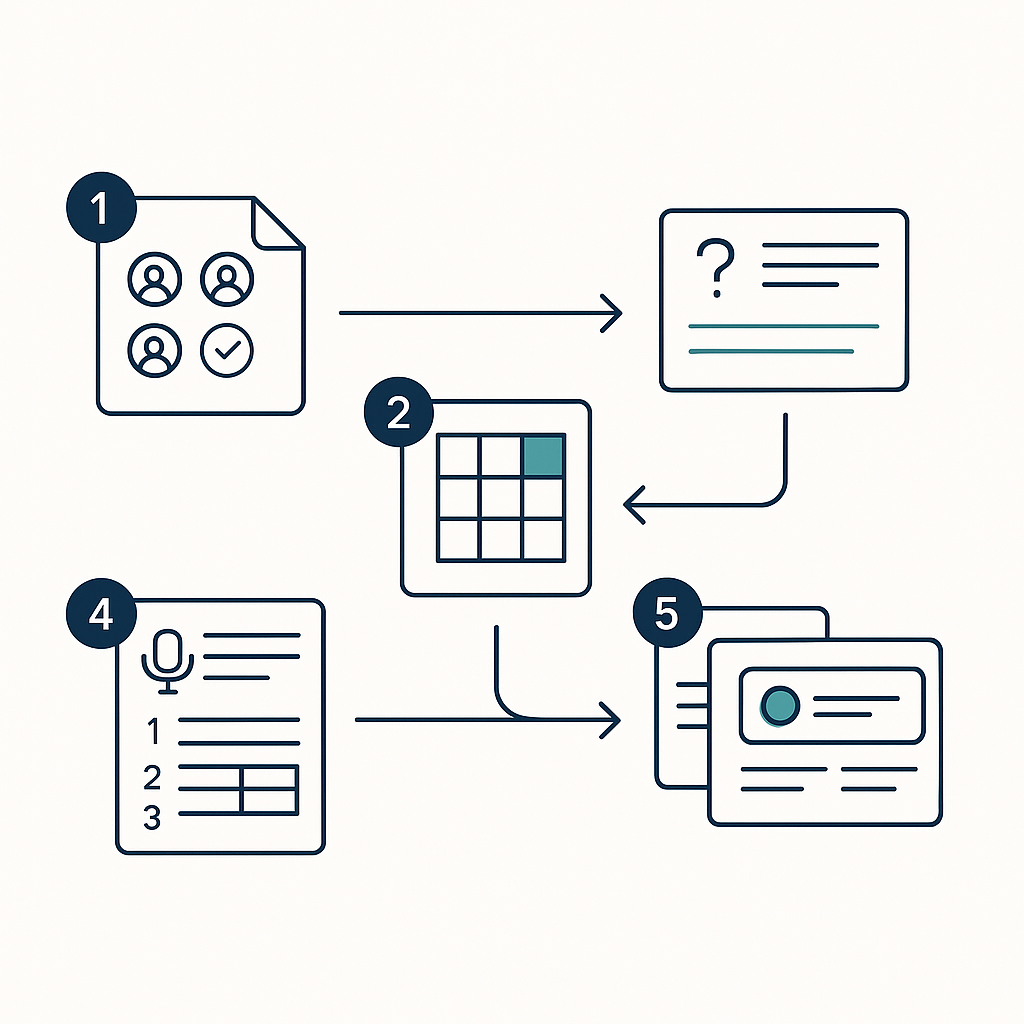
AI visibility is measured with three metrics against a fixed competitor set: visibility score, share of voice and citation gaps. Prompts are checked weekly to catch retrieval shifts, while share of voice is reviewed monthly because it moves slowly and noisy weekly readings invite false conclusions. The method for calculating AI share of voice details how to weight prompts so the number reflects buyer intent rather than vanity queries.
Start Boosting Your AI Visibility
The most direct next step is to run an AI visibility audit on the domain and benchmark it against the competitors AI answer engines already name. Such an audit reports the three metrics the measurement stage defines: visibility score, share of voice, and the citation gaps where a brand is absent from answers it should own. Alef's AI visibility audit starts from a single domain and returns that baseline against a fixed competitor set, giving the answer engine optimization process a measured starting point rather than an assumed one.
Turn this article into a visibility plan
Use Alef to audit your site, find content gaps, and create briefs your team can ship.